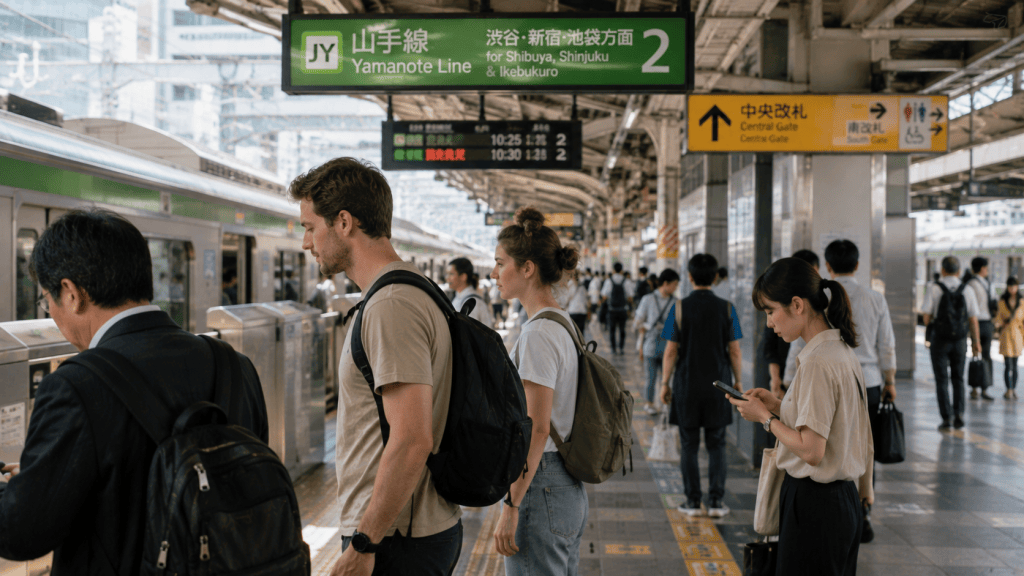
Japan is known for being orderly, clean and easy to travel around, but some everyday customs may feel unfamiliar when you visit for the first time.
You might wonder whether you should talk on the train, where to stand while waiting, when to remove your shoes or what to do before entering an onsen.
The good news is that you do not need to memorize a long list of rules before your trip.
Much of Japanese etiquette comes down to one simple idea: be considerate of the people around you.
Pay attention to your surroundings, follow signs when they are available and observe what local people are doing. If you are unsure, asking politely is usually perfectly fine.
Understanding a few basic customs can still make your trip smoother and help you feel more comfortable in places such as trains, restaurants, temples, traditional accommodations and hot springs.
Here are the essential Japan travel etiquette tips every first-time visitor should know.
1. Be Considerate in Public Spaces
One of the easiest ways to understand etiquette in Japan is to pay attention to how your actions affect the people around you.
In busy stations, shopping streets, restaurants and other shared spaces, try not to block walkways, entrances or escalators while checking your phone or looking at a map.
Keep your luggage close to you, especially in crowded areas, and step aside if you need to stop for a few minutes.
Noise levels can also be quieter than some travelers expect. You do not need to whisper everywhere, but being aware of your volume is a simple way to avoid disturbing others.
You may also notice that public spaces in Japan are often kept remarkably clean. Avoid leaving trash behind, and if you cannot find a trash bin, be prepared to carry it with you until you find an appropriate place to dispose of it.
You do not need to worry about doing everything perfectly. Simply being aware of the people sharing the space with you will help you handle most everyday situations naturally.
2. Keep Your Voice Down on Trains and Buses
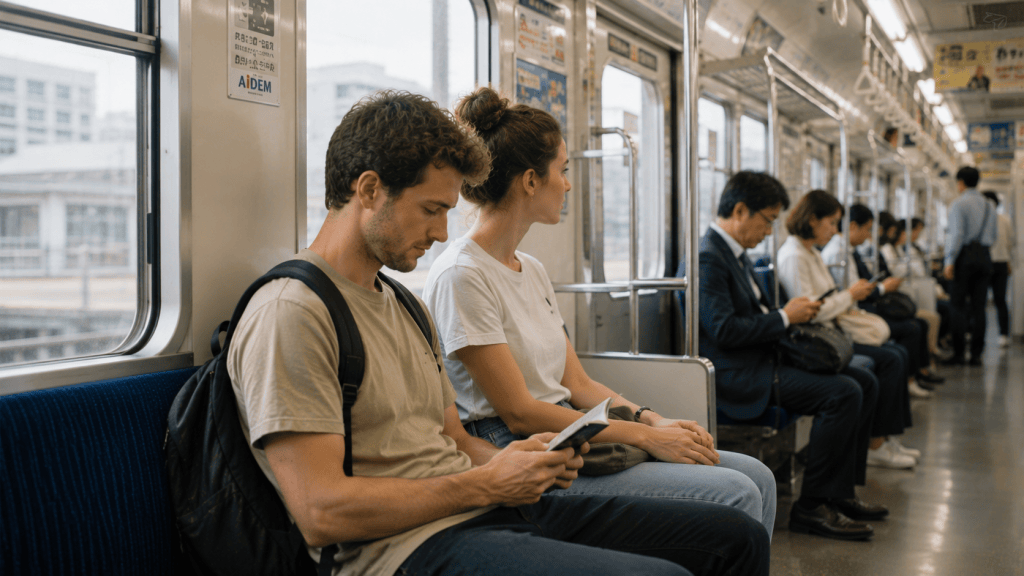
Japan’s trains can be extremely busy, but the inside of a train is often surprisingly quiet.
Talking with your travel companions is fine, but try to keep conversations at a moderate volume. Phone calls are generally avoided on ordinary trains and buses, so use messages instead when possible.
If you are listening to music, watching videos or using social media, use headphones and make sure the sound cannot be heard by other passengers.
When boarding, wait for passengers to get off before you enter. Follow the lines or markings on the platform, and avoid standing directly in front of the doors while people are exiting.
Be mindful of priority seating as well, and offer your seat to passengers who may need it more.
During crowded periods, backpacks and large bags can take up more space than you realize. Keep them under control and avoid blocking aisles or doors.
For a more complete explanation of trains, IC cards and the Shinkansen, see our Getting Around Japan guide.
3. Queue Properly and Let People Exit First
Queuing is an important part of everyday life in Japan, especially at train stations, bus stops, restaurants and busy attractions.
At stations, you will often see lines or markings on the platform showing where passengers should wait. Join the end of the line rather than gathering around the doors.
When the train arrives, allow passengers to get off before you board. The same principle applies to elevators and other crowded entrances.
Restaurants and popular attractions may also have clearly organized waiting lines. Even when the queue looks informal, check whether people are already waiting before moving ahead.
Following the line is simple, but it makes busy public spaces much easier for everyone to use.
4. Know When to Remove Your Shoes
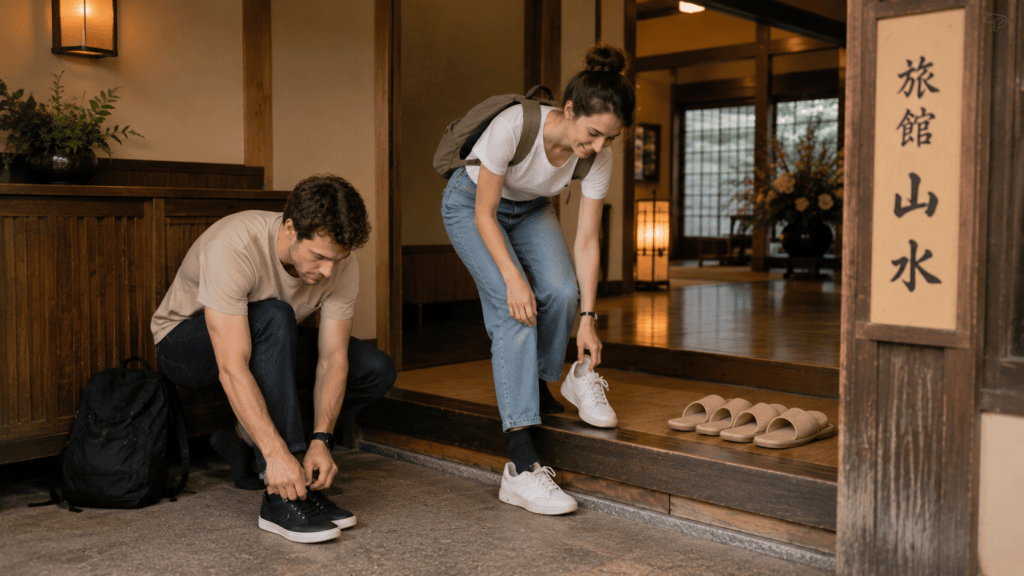
Removing your shoes is one of the Japanese customs that first-time visitors are most likely to encounter.
You will usually remove your shoes when entering a private home, and you may also be asked to do so at traditional ryokan, some restaurants, temples and other places with Japanese-style interiors.
Look for clues such as a raised floor, shoe racks, slippers or signs near the entrance. If everyone else is removing their shoes, you should probably do the same.
When slippers are provided, use them where appropriate, but remember that slippers are generally not worn on tatami mats.
You may also find separate slippers inside a restroom. These are intended only for the restroom, so change back into your regular indoor slippers when you leave.
If you are unsure whether shoes should be removed, simply ask the staff or observe what other people are doing.
Wearing shoes that are easy to take on and off can make this much more convenient during your trip.
5. Understand Basic Dining Etiquette
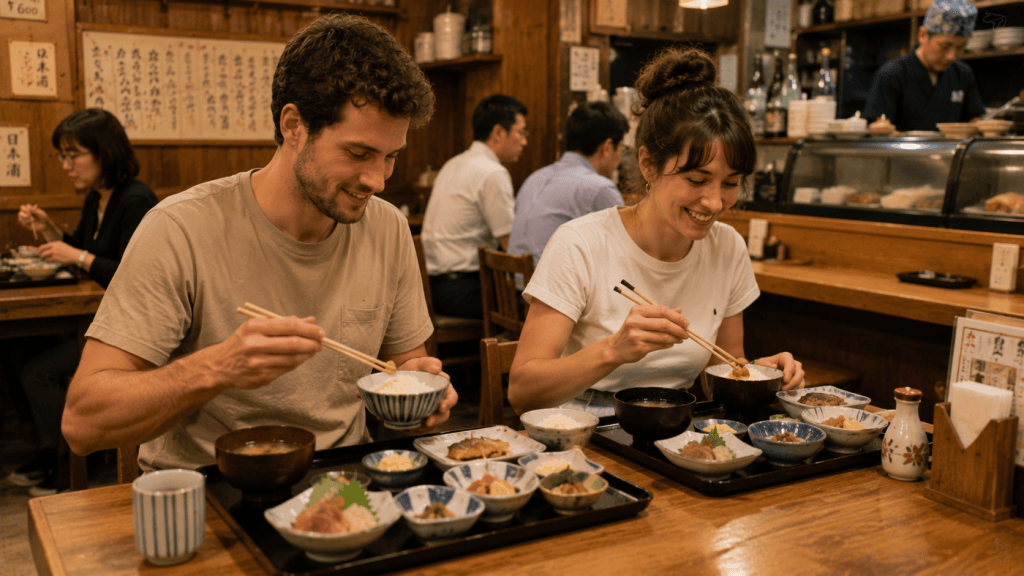
Dining in Japan is generally relaxed, and visitors are not expected to know every traditional table manner.
Before eating, you may hear people say “itadakimasu,” an expression of appreciation for the meal. After finishing, “gochisousama deshita” is commonly used to express thanks for the food.
You do not need to use these phrases, but knowing what they mean can help you understand the dining culture around you.
At many restaurants, a small wet towel called an oshibori is provided before the meal. It is intended for cleaning your hands.
Noodles are another area where visitors sometimes worry about etiquette. Slurping ramen, soba or udon is perfectly acceptable in Japan, but you do not need to do it if it feels unnatural.
Most importantly, pay attention to the atmosphere of the restaurant. A lively izakaya may be noisy and casual, while a small sushi restaurant or traditional dining room may be much quieter.
If you are exploring Japanese cuisine for the first time, our Japanese Food Guide introduces 15 foods worth trying during your trip.
6. Use Chopsticks Respectfully
You do not need perfect chopstick technique to enjoy food in Japan, and restaurant staff will generally understand if you are not used to using them.
However, there are two customs that are especially useful to remember.
Do not leave your chopsticks standing vertically in a bowl of rice.
Do not pass food directly from one pair of chopsticks to another.
Both actions are associated with Japanese funeral customs and are therefore avoided at the dining table.
It is also best not to point at people with chopsticks, wave them around while talking or use them to move plates across the table.
When you are not using your chopsticks, place them on the chopstick rest if one is provided.
If you struggle with chopsticks, do not worry. You can simply ask whether a fork, spoon or another utensil is available.
7. Be Respectful at Temples and Shrines
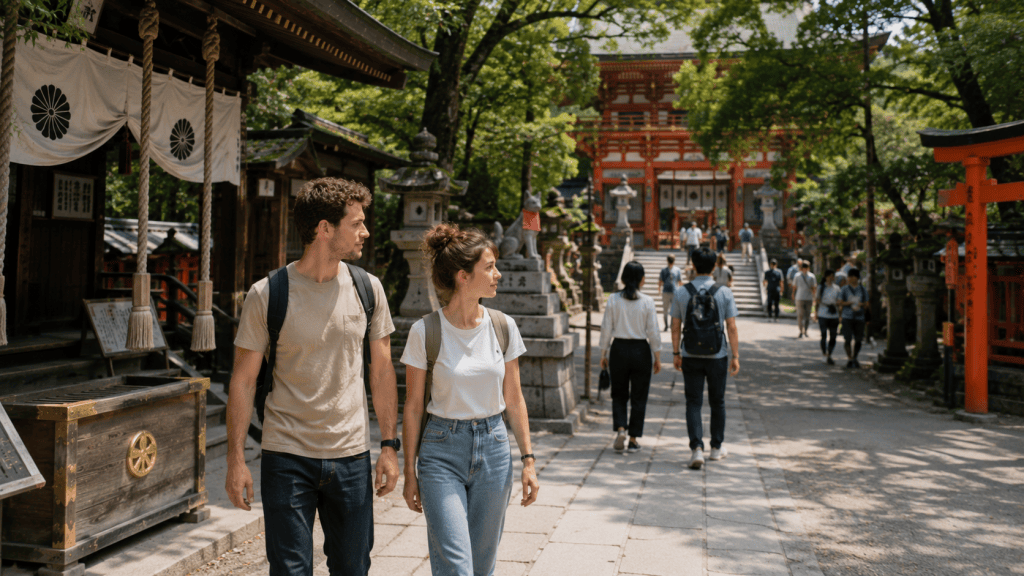
Temples and shrines are some of the most memorable places to visit in Japan, but remember that they are not simply tourist attractions. They are also places of worship.
Keep your voice at a respectful level, avoid blocking entrances or prayer areas and follow any signs or instructions on the grounds.
You may see visitors bowing at gates, washing their hands at a purification fountain or following particular steps when praying. You are welcome to observe and participate, but you do not need to perform every ritual perfectly.
Shrines and Buddhist temples also have different traditions. For example, clapping is commonly part of prayer at Shinto shrines, while it is generally not part of Buddhist temple prayer.
Some temple buildings may require you to remove your shoes, and certain areas may be closed to visitors.
Most importantly, remember that local people may be there to pray rather than sightsee. Give worshippers space and enjoy the atmosphere without treating sacred areas simply as photo opportunities.
8. Ask Before Taking Photos
Japan offers endless opportunities for photography, but not every place or person should be photographed without thinking first.
At temples, shrines, museums, shops and other attractions, look for signs showing whether photography is allowed. Some places allow photos outdoors but restrict them inside certain buildings or sacred areas.
When photographing an individual person as your main subject, ask for permission whenever possible rather than assuming that being in a public place means they want to be photographed.
Be especially careful in crowded tourist areas. Do not block narrow streets, station platforms or entrances while trying to get a photo, and never enter private property or restricted areas for a better angle.
Selfie sticks and tripods may also be prohibited in certain locations, so follow the rules of each place.
Sometimes the best travel photo comes from waiting a few minutes, stepping away from the crowd or simply finding another viewpoint.
9. Learn the Basic Rules Before Entering an Onsen
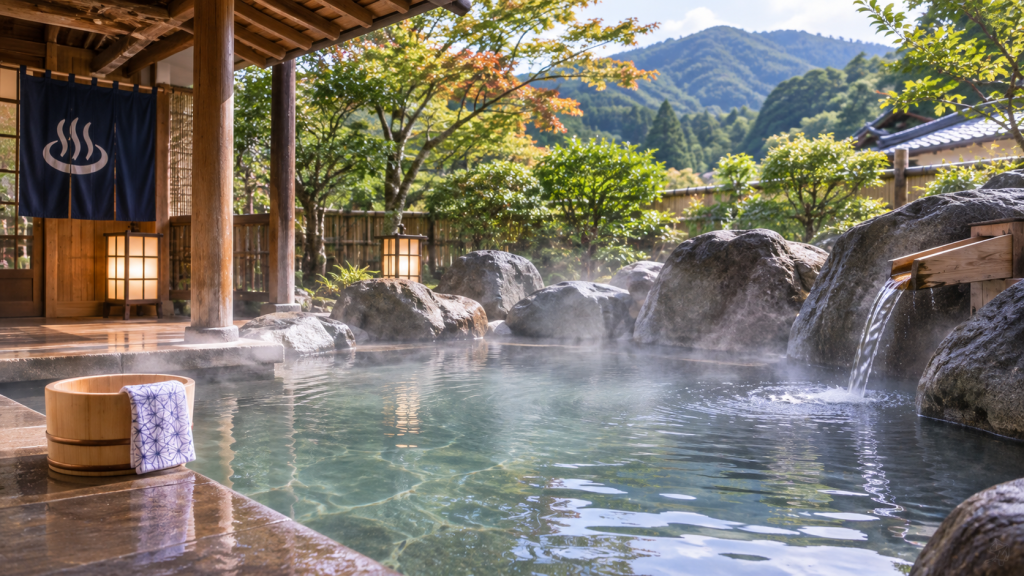
Visiting an onsen can be one of the most memorable experiences in Japan, but the bathing customs may be unfamiliar if it is your first time.
In most traditional onsen, you remove your clothes in the changing area before entering the bathing area. Swimwear is generally not worn in the bath unless the facility specifically says otherwise.
Before entering the hot spring, wash your body thoroughly at the shower area and rinse away all soap and shampoo.
Once you enter the bath, keep your small towel out of the water. You can place it beside the bath or, as you may see other bathers doing, fold it and place it on your head.
Long hair should also be tied up so that it does not enter the water.
An onsen is a place for soaking and relaxing rather than swimming. Keep conversations relatively quiet and avoid splashing or disturbing other bathers.
Phones and cameras should not be used in bathing or changing areas where other guests’ privacy could be affected.
If you have tattoos, check the facility’s policy before visiting. Rules vary considerably: some onsen restrict tattoos, while others accept them, allow small tattoos to be covered or offer private baths.
Do not let the etiquette make you nervous. Most facilities provide instructions, and once you understand the basic routine — wash first, keep towels and hair out of the water, and respect the people around you — the experience is quite simple.
10. Be Prepared to Carry Your Trash
One thing that surprises many first-time visitors is the limited number of public trash bins in Japan.
You may find bins at some train stations, convenience stores, shopping centers and other facilities, but you should not assume that there will always be one nearby.
If you cannot find an appropriate place to dispose of your trash, keep it with you until you do.
Carrying a small bag for wrappers, tissues and other waste can be useful when you spend a full day sightseeing.
When bins are available, pay attention to the labels. Recycling and waste categories may be separated, particularly for plastic bottles, cans and other recyclable items.
Avoid leaving trash beside a full bin or placing it somewhere simply because you cannot find the correct disposal point.
Japan’s clean streets are not the result of having trash bins everywhere. They depend partly on people taking responsibility for the waste they create.
11. Stand Still on Escalators and Follow Local Guidance
You may have heard that people stand on one side of escalators in Tokyo and the opposite side in Osaka.
While you may still notice different habits in different parts of Japan, you do not need to memorize a regional rule.
Current safety guidance encourages passengers to stand still rather than walk on escalators.
Pay attention to signs and announcements, and avoid rushing past other passengers.
If the escalator is wide enough and local guidance encourages passengers to use both sides, simply follow the instructions and the flow around you.
Take extra care when traveling with luggage. Keep a firm grip on your suitcase and make sure it does not block or endanger other passengers.
If you have several bags, a large suitcase, a stroller or limited mobility, using an elevator may be the safer and easier option.
12. Respect the Rules at Hotels and Ryokan
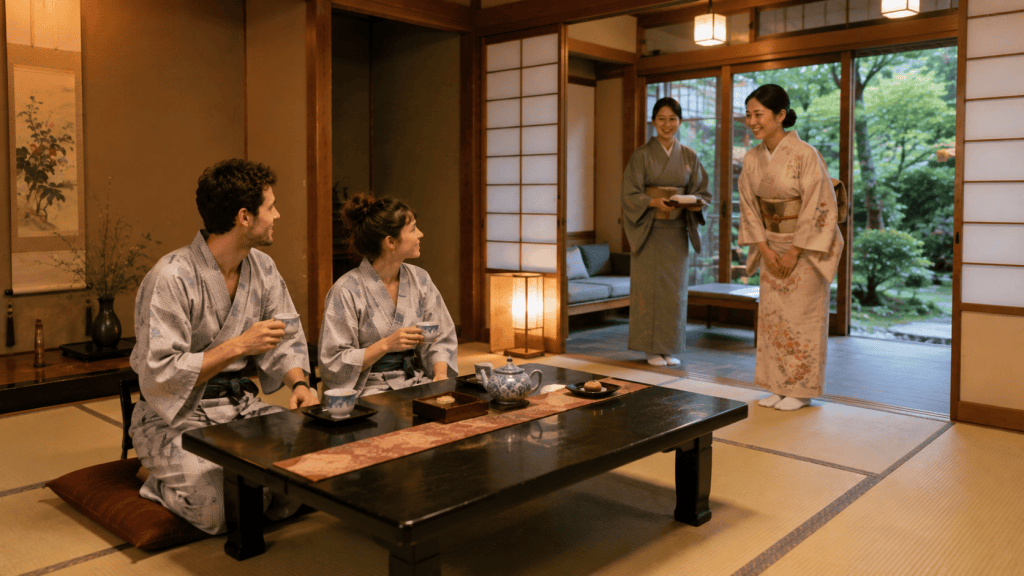
Staying at a hotel in Japan is generally straightforward, but traditional ryokan may have customs that are unfamiliar to first-time visitors.
At a ryokan, you may be asked to remove your shoes near the entrance and use indoor slippers. Remember that slippers should generally be removed before stepping onto tatami flooring.
You may also find a yukata in your room. Whether it can be worn throughout the property or outside the building depends on the accommodation, so check the information provided or ask the staff if you are unsure.
Meals at traditional ryokan may be served at specific times, either in your room or in a dining area. Try to arrive on time, particularly when dinner is included in your stay.
The same applies to check-in and other reservations. If you expect to arrive significantly later than planned, contacting the accommodation is a considerate idea.
Most importantly, do not worry about knowing every ryokan custom before you arrive. Staff are accustomed to helping guests, and asking a simple question is better than worrying about making a mistake.
If you are deciding between hotels, ryokan and other accommodation styles, our Where to Stay in Japan guide explains the main options for travelers.
13. A Simple Bow Is Usually Enough
Bowing is one of the customs most strongly associated with Japan, but visitors do not need to learn complicated rules about different types or angles of bows.
In everyday travel situations, a small nod or gentle bow is usually enough to show politeness.
You may naturally use one when thanking hotel staff, greeting someone, apologizing or leaving a restaurant or shop.
Do not worry if your bow is not perfect. Japanese people do not generally expect international visitors to understand every detail of formal bowing etiquette.
Simple Japanese expressions can also make everyday interactions easier. “Arigato gozaimasu” is a polite way to say thank you, while “sumimasen” is useful when saying excuse me, getting someone’s attention or apologizing.
Even a few words combined with a friendly and respectful attitude can go a long way.
The goal is not to imitate every Japanese custom perfectly. It is simply to communicate politely and show consideration for the person you are interacting with.
14. Be on Time for Reservations
Punctuality matters when you have a reservation in Japan, particularly for restaurants, accommodations, tours and other experiences with a specific starting time.
Try to arrive a few minutes early rather than planning to reach the venue at the exact reservation time.
This is especially important at restaurants serving set menus or courses. Some dishes may be prepared according to your reservation time, and arriving late can affect both the restaurant and other guests.
If you realize that you are going to be late, contact the restaurant, hotel or activity provider as soon as possible.
The same applies if your plans change completely. Do not simply skip a reservation without letting the business know. Cancel as early as you can so the venue has an opportunity to offer the space to someone else.
Japan’s large cities and railway stations can also take longer to navigate than they appear on a map, so leave enough travel time between reservations.
A little extra time in your schedule is much less stressful than rushing across a city to avoid missing a booking.
15. When in Doubt, Observe and Ask
No matter how much you prepare, you will eventually encounter a situation in Japan where you are not sure what to do.
Maybe you do not know whether to remove your shoes, where to queue, whether photography is allowed or how something works at a restaurant.
You do not need to panic or worry about accidentally breaking an unfamiliar rule.
Look for signs, observe what people around you are doing and ask a staff member if you are still unsure.
A simple “sumimasen” can help you politely get someone’s attention, and translation apps can make more complicated questions much easier.
Most importantly, approach unfamiliar situations with patience and consideration rather than worrying about doing everything exactly like a local.
Good travel etiquette is not about memorizing dozens of rules. It is about respecting the people, places and communities you encounter along the way.
If you want to avoid other common problems on your first trip, our Japan Travel Mistakes guide covers 15 mistakes travelers often make — and how to avoid them.
Conclusion: Respect the Culture, but Enjoy Your Trip
Japanese etiquette can seem complicated when you first start researching your trip, but most visitors do not need to memorize a long list of rules.
Keep your voice at a reasonable level, respect queues, follow signs, be considerate in shared spaces and pay attention to the people around you.
Some situations — such as visiting an onsen, entering a traditional ryokan or using chopsticks — have customs worth learning in advance. Others can be handled simply by observing what local people are doing.
You will probably make a small mistake at some point, and that is okay. Traveling somewhere new means learning as you go.
Approach Japan with curiosity, patience and respect, and these customs will quickly begin to feel natural.
Understanding the basics will not only help you avoid awkward situations. It can also help you feel more confident exploring Japan and make your interactions with the people you meet more enjoyable.
 Beyond Japan Guide
Leave a comment