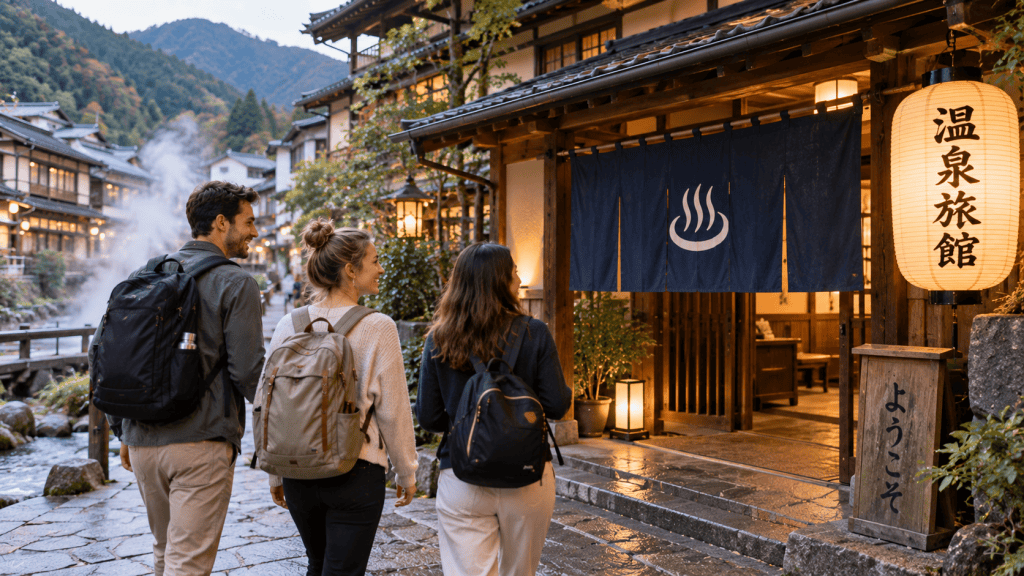
Visiting an onsen can be one of the most memorable experiences of a trip to Japan.
Natural hot springs can be found throughout the country, from mountain towns and traditional ryokan to modern hotels and day-use bathing facilities.
But for first-time visitors, using an onsen can also feel intimidating.
Should you wear a swimsuit? Where do you wash? Can you bring a towel into the bath? What happens if you have tattoos?
The rules are not complicated once you understand the basic routine, but Japanese bathing customs are different from those in many other countries.
Japan’s official tourism website also provides a helpful introduction to onsen etiquette and bathing customs for international visitors.
Most importantly, an onsen is a shared space where cleanliness, consideration for other bathers and respect for the rules of each facility matter.
Tattoo policies also vary. Some facilities allow tattoos, some may permit small tattoos if they are covered, and others may not allow tattooed guests in shared bathing areas. Private baths can sometimes provide an alternative, depending on the property.
This guide explains how to use an onsen in Japan, the essential etiquette to know, what to bring, what first-time visitors should expect and how to approach tattoo restrictions before you visit.
1. What Is an Onsen?
An onsen is a Japanese hot spring that uses naturally occurring hot spring water from underground.
Japan’s volcanic geography has created hot spring areas throughout the country, and onsen can be found in mountain towns, coastal regions, traditional ryokan and dedicated bathing facilities.
Some onsen are indoors, while others have outdoor baths known as rotenburo.
You may also come across the word sento during your trip. A sento is a public bath that traditionally uses heated tap water rather than natural hot spring water, so it is not exactly the same as an onsen.
For travelers, however, the basic bathing etiquette can be very similar.
Most public onsen have separate bathing areas for men and women, although there are exceptions. Private baths are also available at some ryokan and hot spring facilities.
You do not need to stay overnight at a ryokan to experience an onsen. Many facilities offer day-use bathing, making it possible to enjoy a hot spring as part of a sightseeing day.
2. How to Use an Onsen Step by Step
The exact layout varies from one onsen to another, but the basic routine is usually easy to understand.
First, leave your shoes where required and enter the appropriate changing area.
Remove your clothes and store your belongings in the locker, basket or other storage space provided.
Take only the items permitted into the bathing area, which will usually include a small towel.
Before entering the hot spring, go to the washing area and wash your body thoroughly.
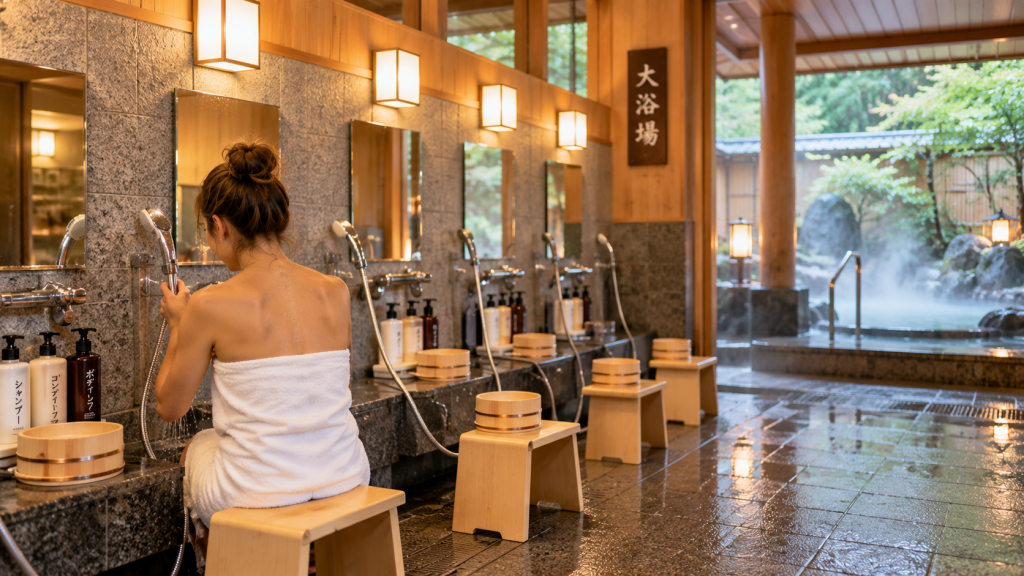
Rinse away all soap and shampoo before approaching the bath.
Enter the water slowly, especially if you are not accustomed to very hot baths.
Relax quietly, keep your towel and hair out of the water and avoid disturbing other bathers.
When you have finished, return to the changing area, dry yourself and get dressed.
Signs and procedures vary between facilities, so always follow the instructions provided by the onsen you are visiting.
3. Wash Before Entering the Bath
One of the most important rules of onsen etiquette is to wash before getting into the shared bath.
The hot spring itself is for soaking and relaxing, not for washing your body.
Most facilities have a washing area with low stools, hand-held showers, buckets and toiletries such as soap and shampoo.
Sit at one of the washing stations and clean yourself thoroughly.
When you have finished, rinse away all soap and shampoo before entering the bath.
Be considerate of the people around you while using the shower. Avoid spraying water toward other bathers and leave the washing area reasonably tidy when you finish.
Even if you showered shortly before arriving, follow the facility’s normal bathing routine rather than walking directly into the hot spring.
Keeping the shared water clean is one of the central ideas behind Japanese bathing etiquette.
4. Do You Wear a Swimsuit in an Onsen?
In a typical Japanese onsen, you do not wear a swimsuit.
Most traditional public baths are separated by gender, and guests remove their clothing in the changing area before entering the bathing area.
This can feel unfamiliar if you come from a country where public bathing normally involves swimwear.
However, bathing without clothing is a normal part of onsen culture, and other guests are generally focused on enjoying the bath rather than paying attention to the people around them.
A small towel can provide some modesty while walking around the bathing area, but it should not be placed in the bathwater.
There are exceptions to the usual no-swimsuit rule. Certain mixed-gender or specialized facilities may require specific bathing clothing or swimwear.
Never assume, however, that you can wear a swimsuit simply because you feel more comfortable doing so.
Follow the rules of the individual facility.
If bathing without clothing makes you uncomfortable, consider choosing a private bath instead.
5. What Should You Do With Your Towel?
Towels have a specific role in Japanese onsen etiquette.
Many facilities use two types: a larger towel for drying yourself and a smaller towel that can be taken into the bathing area.
Leave the large bath towel in the changing area unless the facility instructs otherwise.
The small towel can be used while washing or for modesty as you move around the bathing area.
Once you enter the bath, however, do not put the towel into the hot spring water.
You can place it beside the bath where permitted or fold it and place it on your head.
The same cleanliness principle applies to your hair. If you have long hair, tie it up so that it does not fall into the water.
These details may seem unusual at first, but after watching how the bathing area works, the routine quickly becomes natural.
6. Can You Use an Onsen in Japan With Tattoos?
Having a tattoo does not automatically mean that you cannot experience an onsen in Japan.
However, tattoo policies vary considerably between facilities.
Some onsen allow tattooed guests without restrictions, while others do not allow tattoos in shared bathing areas.
Certain facilities may allow small tattoos if they are completely covered with an approved patch or cover sheet. Others may not permit tattoos even when they are covered.
For this reason, do not assume that a rule you encountered at one onsen will apply to another.
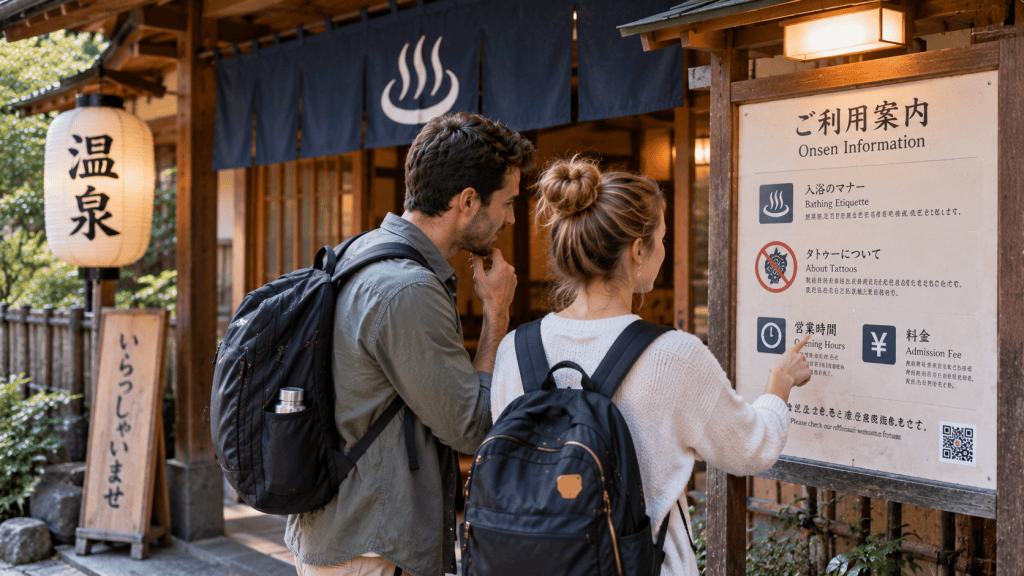
Check the facility’s official website before visiting. If the policy is unclear, contact the property or ask the staff before entering the bathing area.
For additional guidance, Japan’s official tourism website explains more about onsen, tattoos and bathing etiquette.
Travelers with larger tattoos may find it easier to look specifically for tattoo-friendly facilities or choose a private bath.
Planning ahead is much better than arriving at an onsen and discovering that you cannot use the shared baths.
7. Private Onsen Can Be a Good Alternative
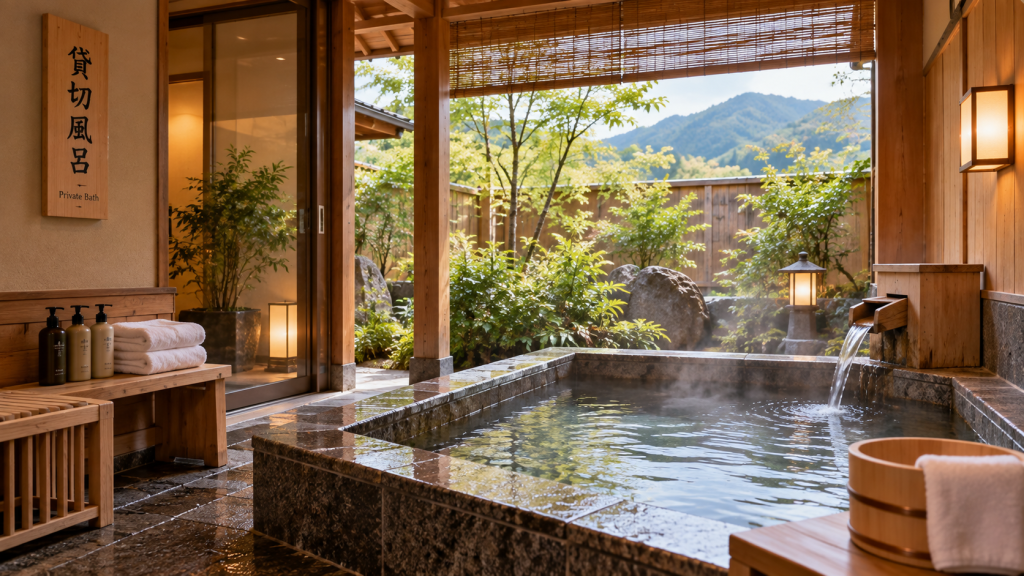
A private bath can be an excellent option if you prefer more privacy or do not feel comfortable bathing with strangers.
In Japan, you may see private baths described as kashikiri-buro, meaning a bath reserved for private use.
Some ryokan have private baths that guests can reserve for a limited period, while others offer guest rooms with their own indoor or open-air bath.
Private baths can also be useful for couples or families who want to enjoy the experience together rather than using separate gender-specific bathing areas.
They may also provide an alternative for travelers with tattoos, although you should still confirm the property’s policy before booking.
Availability and pricing vary considerably. Some private baths are included with particular accommodation plans, while others require an additional fee or advance reservation.
If using a shared public bath makes you hesitant about trying an onsen, choosing accommodation with a private bathing option can make your first experience much easier.
8. Make Sure You Enter the Correct Bath
Most onsen have separate bathing areas for men and women.
At the entrance to the changing rooms, look for signs, colors or the Japanese characters 男 for men and 女 for women.
Many tourist-friendly facilities also provide English signs.
Do not rely only on the color of the entrance curtain, because colors and designs are not necessarily the same at every facility.
At some ryokan, the men’s and women’s bathing areas may switch at different times of the day so that guests can experience different baths.
This means the entrance you used the previous evening may not be the correct one the following morning.
Check the sign each time you enter rather than simply following your memory.
If you are unsure which bathing area to use, ask the staff before entering.
9. What Should You Bring to an Onsen?
You usually do not need to carry much into an onsen.
If you are staying at a ryokan or hotel, towels and basic toiletries are often provided, although the exact amenities depend on the property.
Day-use facilities may provide towels, rent them for a fee or expect visitors to bring their own.
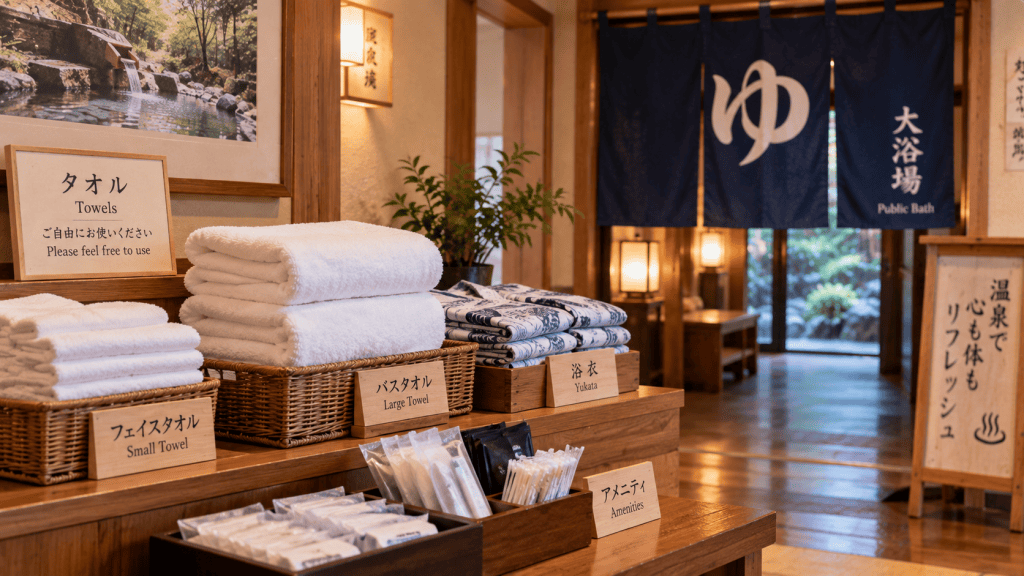
Before visiting, check whether you need to bring or rent:
- a small washing towel
- a larger bath towel
- shampoo and body wash
- basic toiletries
- hair ties if you have long hair
- any permitted tattoo cover required by the facility
Leave valuables in a secure locker or another location recommended by the facility.
You should also leave your phone and camera outside the bathing area unless the facility explicitly provides a place where their use is permitted.
Because people are bathing without clothing, photography in ordinary shared bathing areas should never be assumed to be acceptable.
The simplest approach is to arrive with only what you need and follow the facility’s instructions.
10. How Should You Behave Inside an Onsen?
An onsen is a place to relax, so the atmosphere is generally calm and quiet.
You do not need to remain completely silent, but keep conversations at a considerate volume and avoid behavior that disturbs other bathers.
Do not swim, splash or treat the bath like a swimming pool.
Keep your towel, hair and personal items out of the water.
Avoid taking up more space than you need, particularly when the bath is busy.
Phones and cameras should remain outside ordinary shared bathing areas unless the facility specifically indicates otherwise.
The water can also be hotter than you expect.
Enter slowly, take breaks when you need them and do not feel that you have to stay in the bath for a long time to have a proper onsen experience.
Most importantly, pay attention to the people around you and follow any instructions displayed by the facility.
Good onsen etiquette is less about memorizing dozens of rules and more about keeping the shared space clean, quiet and comfortable for everyone.
For more everyday customs to know before your trip, see our Japan Travel Etiquette guide.
11. Staying at a Ryokan With an Onsen
Staying at a ryokan with its own onsen is one of the easiest ways to combine a traditional Japanese accommodation experience with hot spring bathing.
Many onsen ryokan have shared indoor or outdoor baths that overnight guests can use during designated hours.
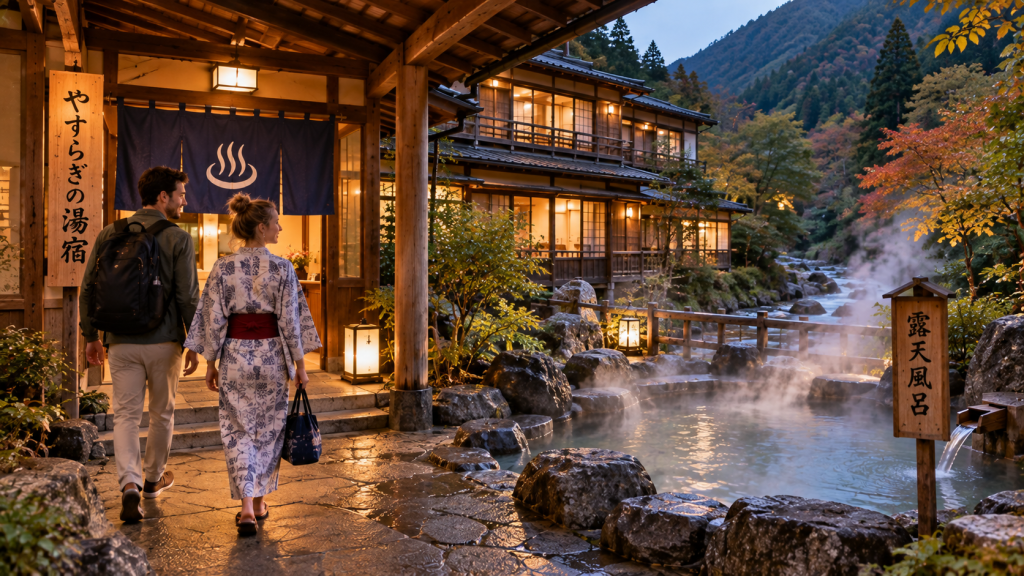
Some properties also offer private baths or guest rooms with their own bathing facilities.
After checking in, the staff will usually explain where the baths are located, when they are open and whether there are any specific rules you should know.
You may also be provided with a yukata, a lightweight Japanese robe that guests commonly wear around the ryokan.
One of the advantages of staying overnight is that you do not have to rush your onsen experience into a short sightseeing schedule.
Depending on the property’s opening hours, you may be able to bathe in the evening and again the following morning.
If the onsen is an important reason for choosing the accommodation, check exactly what the property offers before booking. A private bath, an open-air bath and an onsen bath inside your own guest room are different features and should not be assumed to be included simply because a property describes itself as a ryokan.
If you are deciding between a ryokan and other accommodation options, our Where to Stay in Japan guide explains the main types of places to stay and what travelers can expect from each.
12. You Can Visit an Onsen Without Staying Overnight
You do not need to stay at a ryokan to enjoy an onsen in Japan.
Many hot spring facilities offer day-use bathing, allowing visitors to pay an admission fee and use the baths without booking accommodation.
Some ryokan also open their baths to non-staying guests during certain hours.
This can be a convenient option if you are visiting an onsen town as a day trip or simply want to experience a Japanese hot spring without spending the night.
Day-use hours may be more limited than the hours available to overnight guests, and access can sometimes change depending on occupancy, maintenance or other conditions.
Towels and toiletries may be included, available for rent or require an additional fee depending on the facility.
Before making a special journey, check the facility’s official website for current opening hours, admission details and any rules that apply to day visitors.
If a particular onsen is important to your itinerary, avoid relying only on old blog posts or travel reviews because operating conditions can change.
13. What Is a Rotenburo?
A rotenburo is an open-air bath.
These outdoor baths are one of the most memorable ways to experience an onsen, particularly when they overlook mountains, forests, rivers or other natural scenery.
The bathing routine is generally the same as for an indoor onsen: wash first, keep towels and hair out of the water and follow the rules of the facility.
What makes a rotenburo different is the setting.
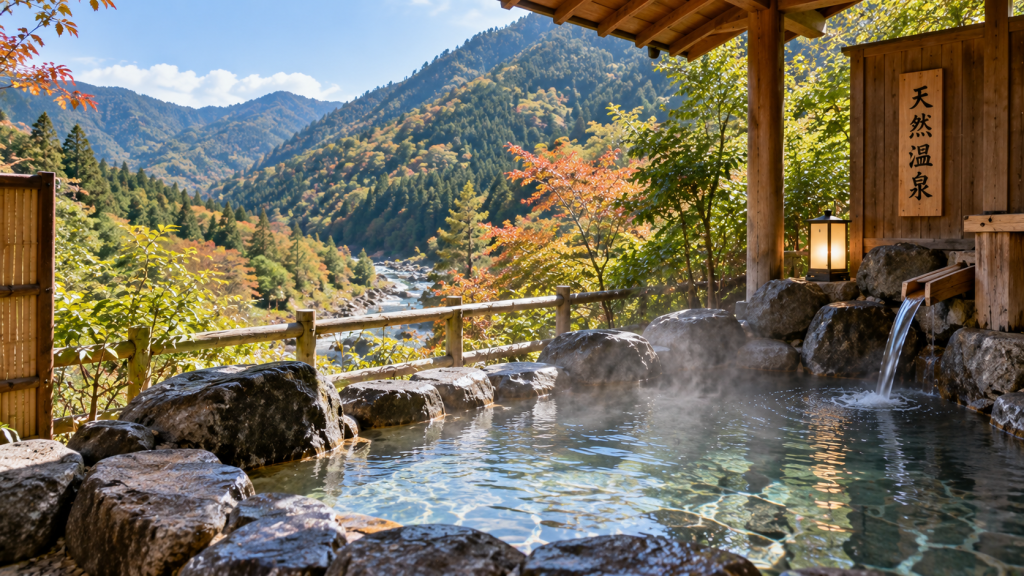
Depending on where and when you visit, you might soak while surrounded by autumn leaves, winter snow, fresh spring greenery or cool mountain air.
Some facilities have both indoor and outdoor baths, allowing you to move between them during the same visit.
Outdoor conditions also mean that surfaces can occasionally be wet, cold or slippery, so move carefully when entering and leaving the bath.
A beautiful view can make a rotenburo special, but the same shared-bathing etiquette still applies.
14. When Is the Best Time to Visit an Onsen?
Onsen can be enjoyed throughout the year, and each season offers a different experience.
Winter is especially popular because soaking in hot water while the air is cold can be extremely relaxing. In snowy regions, an outdoor bath surrounded by snow can be one of Japan’s most memorable winter experiences.
Spring can bring cherry blossoms and fresh greenery to some hot spring areas.
Summer offers lush landscapes, although the combination of hot weather and hot water may feel less appealing to some travelers.
Autumn is another particularly attractive season, with many mountain onsen areas surrounded by colorful foliage.
There is no single best month for everyone.
Choose the season based on the rest of your itinerary rather than planning your entire trip around the idea that onsen should only be experienced in winter.
Weather conditions also vary considerably across Japan, so a snowy onsen experience depends heavily on the destination as well as the month you visit.
For a broader look at Japan’s seasons, weather and when to travel, see our Best Time to Visit Japan guide.
15. First-Time Onsen Mistakes to Avoid
Most first-time onsen mistakes are easy to avoid once you know the basic routine.
One of the most common is entering the bath before washing properly.
Other mistakes include putting a towel into the shared water, allowing long hair to fall into the bath, wearing a swimsuit where it is not permitted or speaking too loudly in a quiet bathing area.
Travelers with tattoos should also avoid assuming that every facility follows the same policy.
Another mistake is arriving without checking practical details such as opening hours, day-use availability or whether towels are provided.
Do not bring your phone into an ordinary shared bathing area simply because you want to take a photograph of the experience.
Finally, do not worry so much about making a small mistake that you cannot relax.
Read the facility’s instructions, observe the basic etiquette and be considerate of the people around you.
Once you understand the routine, using an onsen is usually much simpler than it first appears.
For more practical problems to avoid on your first trip, read our Japan Travel Mistakes guide.
Conclusion: Enjoy Your First Onsen With Confidence
Visiting an onsen for the first time may feel unfamiliar, but the basic rules are easier to follow than they initially appear.
Wash thoroughly before entering the bath, keep your towel and hair out of the water, respect the quiet atmosphere and follow the rules of the individual facility.
If you have tattoos, check the policy before visiting rather than assuming that every onsen follows the same rules. Tattoo-friendly facilities and private baths can provide alternatives when shared bathing areas are restricted.
You also do not need to stay at a luxury ryokan to experience Japan’s hot spring culture. Day-use facilities, local onsen and traditional inns offer many different ways to enjoy the experience.
Whether you visit an outdoor bath surrounded by mountains, stay overnight at an onsen ryokan or simply stop at a hot spring during your journey, take your time and enjoy the experience rather than worrying about doing everything perfectly.
Once you understand the basic etiquette, an onsen can become one of the most relaxing and memorable experiences of your trip to Japan.
 Beyond Japan Guide
Leave a comment