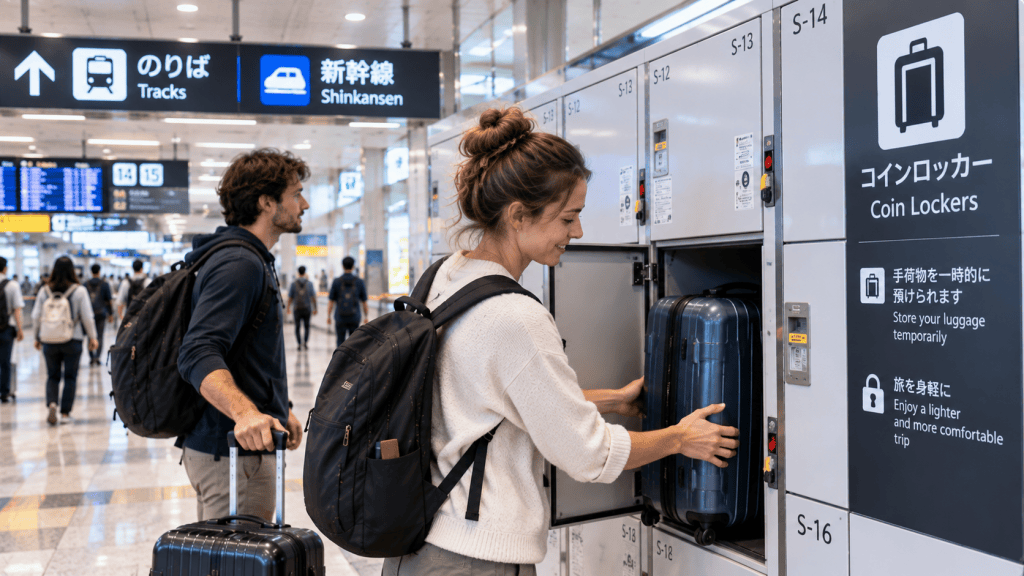
Carrying a suitcase around Japan can quickly become inconvenient, especially when you arrive before hotel check-in or want to explore a city between train journeys.
One simple solution is to use a coin locker.
Coin lockers are commonly found at train stations and other busy transportation areas in Japan, allowing travelers to store bags temporarily while they explore without carrying everything with them.
Despite the name, modern lockers do not always require coins. Depending on the locker, you may be able to pay with cash, an IC card or another supported cashless payment method.
Locker sizes, prices, payment methods and maximum storage periods vary by location, so it is important to check the instructions on the specific locker you are using.
Large stations can have many locker areas, but they can also become busy during weekends, holidays and other popular travel periods.
This guide explains how coin lockers work in Japan, how to choose the right size, how to pay, what to do when lockers are full and when luggage delivery may be a better option.
1. What Are Coin Lockers in Japan?
Coin lockers are self-service storage lockers that allow you to leave luggage temporarily and collect it later.
Travelers commonly use them when they arrive before accommodation check-in, have time to explore after checking out or want to visit somewhere without carrying a suitcase.
You will often find lockers at major railway and subway stations, although availability varies by station and location.
Some airports, shopping areas and other transportation facilities may also provide lockers or alternative baggage storage services.
The basic idea is straightforward: find an available locker, place your belongings inside, pay the required fee and keep whatever key, receipt, PIN or other information is required to open it again.
The exact procedure depends on the locker system.
Do not assume that every locker in Japan works in exactly the same way, even when two locker areas are located in the same station.
2. Where Can You Find Coin Lockers?
Train stations are one of the most common places travelers encounter coin lockers in Japan.
At larger stations, lockers may be located near ticket gates, station entrances, underground passages or other areas throughout the station complex.
Some railway operators provide official locker information online. For example, Kintetsu Railway’s coin locker guide lists locker sizes and availability at many major stations in Osaka, Kyoto, Nara, Nagoya and other areas.
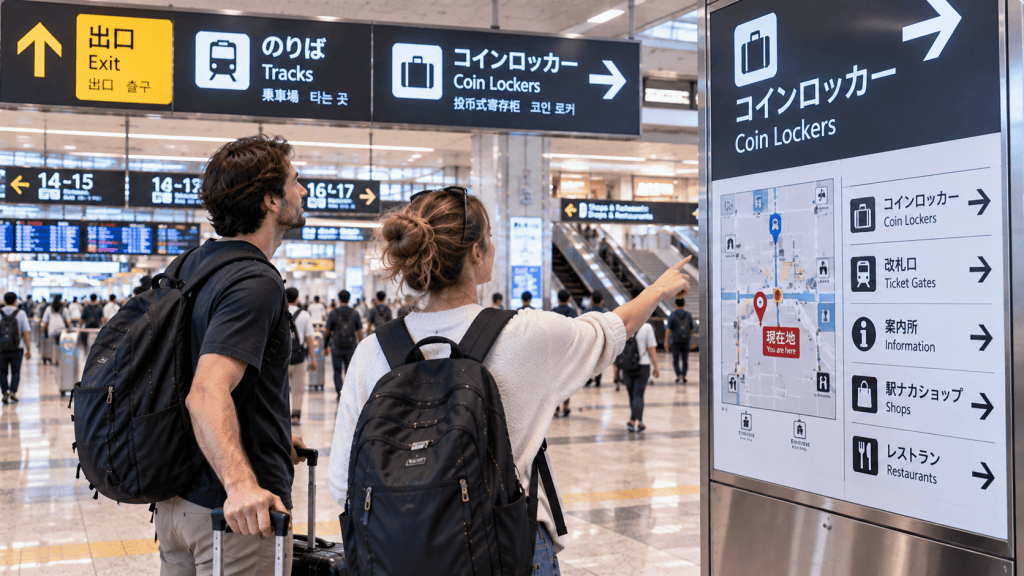
This creates an important problem for first-time visitors: remembering where you left your luggage.
A major station can have several exits, floors, railway operators and separate locker areas.
Before walking away, take a photo of the locker area and nearby signs.
It is also useful to record the locker number, floor, nearest exit and any other landmark that will help you return to the same location.
Do not rely on remembering that your suitcase is simply “somewhere inside Shinjuku Station” or another large station.
If you cannot find an available locker, look for signs directing you to another locker area or ask station staff whether other baggage storage options are available.
3. What Size Coin Locker Do You Need?
Coin lockers come in different sizes.
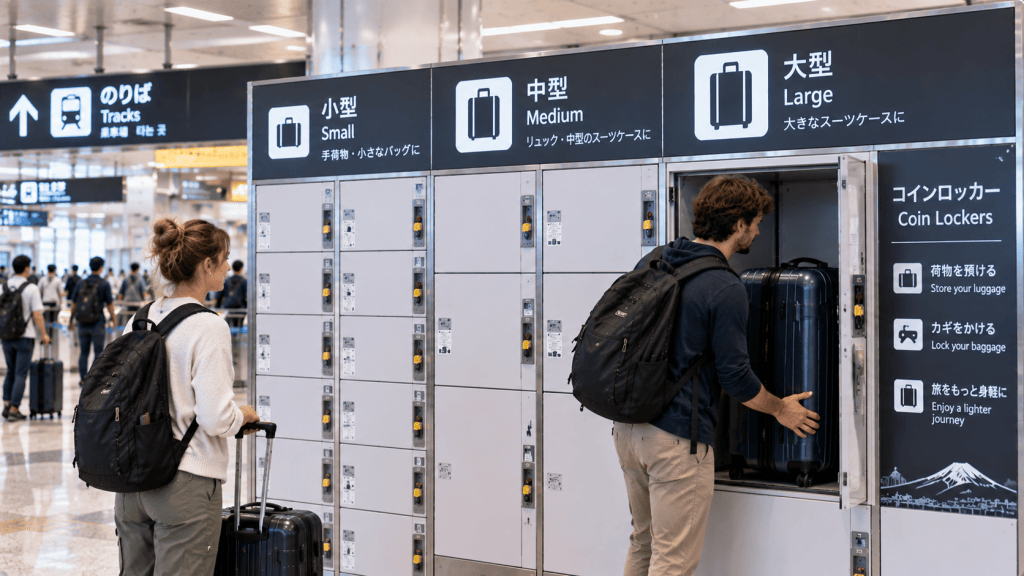
Smaller lockers may be suitable for backpacks, shopping bags and other compact belongings, while larger lockers may accommodate suitcases.
However, locker dimensions are not standardized across every station and locker system.
A suitcase that fits inside one large locker may not fit inside another.
For this reason, do not choose a locker only because it is labeled “large.”
Look at the available space and any dimensions or size information displayed at the locker before paying.
If you are traveling with an oversized suitcase, finding a suitable locker can be more difficult.
In that situation, a staffed baggage storage service or luggage forwarding may be more practical.
Packing relatively light also gives you more flexibility when using trains, stations and temporary storage during your trip.
If you are still preparing for your trip, our Japan Packing List can help you decide what you actually need to bring.
4. How Do You Pay for a Coin Locker?
Payment methods depend on the locker.
Traditional lockers may accept coins, while newer electronic lockers may support transportation IC cards or other payment methods.
For example, JR East explains that some compatible lockers allow Suica to be used both for payment and as the key for retrieving your luggage.
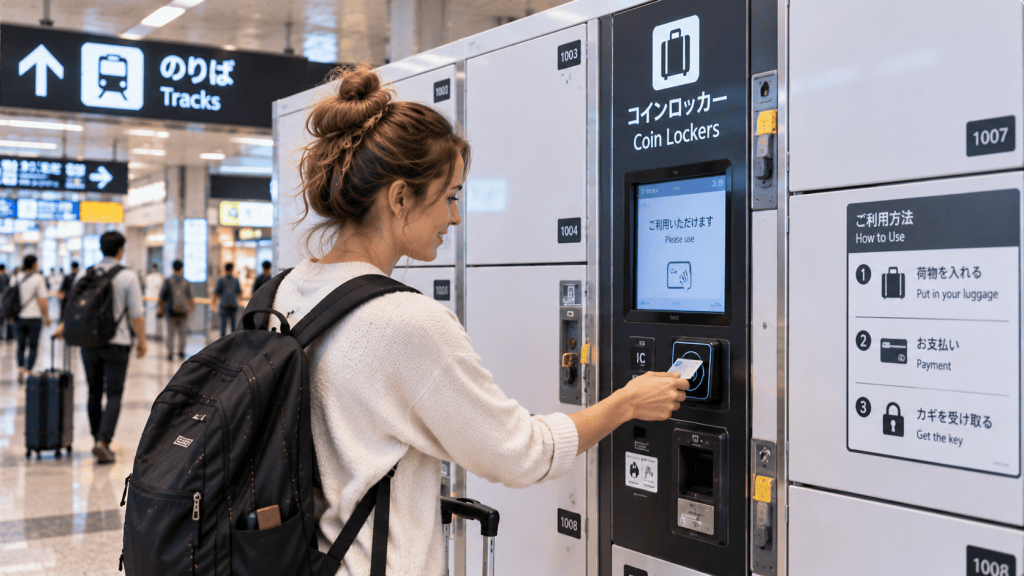
Some systems use a physical key after payment.
Others may provide a receipt, PIN, QR code or another method for reopening the locker.
Follow the instructions displayed on the machine rather than assuming that it will work like a locker you used somewhere else in Japan.
If you use an IC card to lock your belongings, remember which card you used.
You may need the same card when you return to retrieve your luggage.
It is also sensible to keep the receipt or other information provided by the locker until your belongings have been collected successfully.
For travelers already using an IC card for transportation, compatible electronic lockers can make temporary luggage storage particularly convenient.
Our Getting Around Japan guide explains how IC cards work for trains and other everyday transportation during your trip.
5. How Much Do Coin Lockers Cost?
Coin locker prices vary depending on the locker size, location and operator.
Larger lockers generally cost more than smaller ones, and fees can differ between stations or storage systems.
For that reason, it is better not to plan your trip around one nationwide fixed locker price.
Check the price displayed on the locker before storing your belongings.
You should also check how the locker calculates its storage period.
A locker fee is not necessarily based on a simple 24-hour period from the exact moment you store your bag.
Depending on the system, additional charges may apply when the storage period passes a specified time or date boundary.
If you plan to leave luggage for more than a short sightseeing period, read the locker instructions carefully before paying.
For ordinary temporary storage, the convenience of leaving a heavy bag behind can often be more important than finding the absolute cheapest locker.
6. How Long Can You Leave Luggage in a Coin Locker?
Coin lockers are designed mainly for temporary storage rather than long-term luggage storage.
The maximum storage period varies depending on the station, operator and locker system.
Some lockers may allow luggage to remain for more than one day, but additional fees can apply and there is usually a limit on how long belongings can stay inside.
If that limit is exceeded, your belongings may be removed from the locker and transferred to another storage or lost-property facility according to the operator’s rules.
This can make retrieving your luggage much more complicated.
For that reason, always check the instructions displayed on the locker if you plan to leave your belongings overnight or for more than a few hours.
Do not assume that a locker can simply remain occupied until you return several days later.
If you need to store luggage for a longer period, a staffed baggage storage service or another dedicated storage option may be more appropriate.
7. What Should You Do When Coin Lockers Are Full?
Finding an empty locker can be difficult at busy stations, particularly during weekends, holidays and popular travel periods.
Large lockers suitable for suitcases can be especially difficult to find because there are often fewer of them than smaller lockers.
If the first locker area is full, do not immediately assume that the entire station has no available lockers.
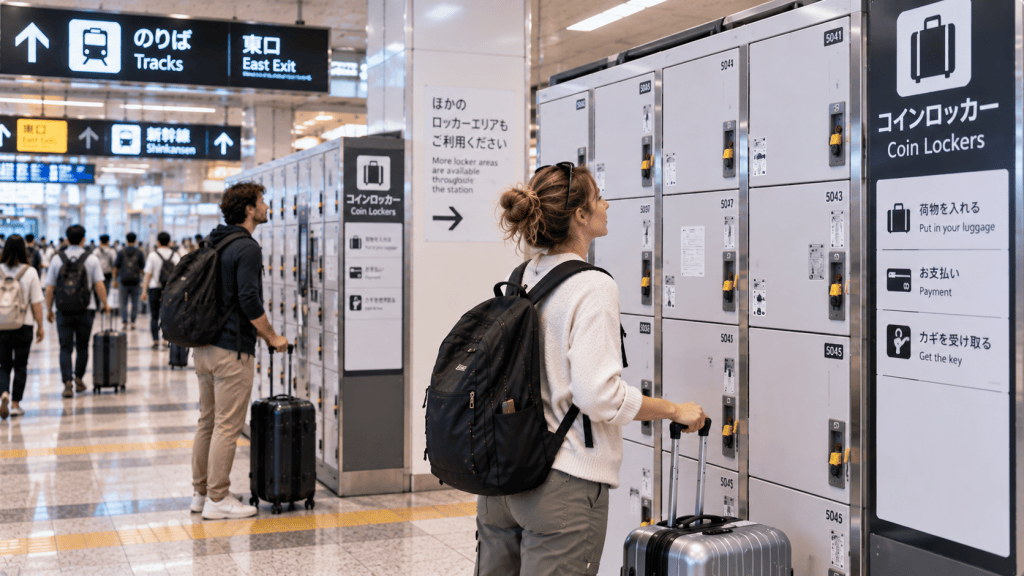
Large stations may have several locker areas in different parts of the station.
Check station maps and signs, or ask station staff whether there are other lockers nearby.
Some stations and surrounding areas may also have staffed luggage storage services.
If you know that you will need luggage storage on a particularly busy travel day, it is sensible to have an alternative plan rather than depending entirely on finding an empty locker.
You may also find it easier to store your luggage at a station before reaching the busiest tourist area, depending on your itinerary.
8. Can Large Suitcases Fit in Coin Lockers?
Some coin locker areas have larger compartments designed to hold suitcases.
However, the number and dimensions of large lockers vary, and oversized luggage may not fit.
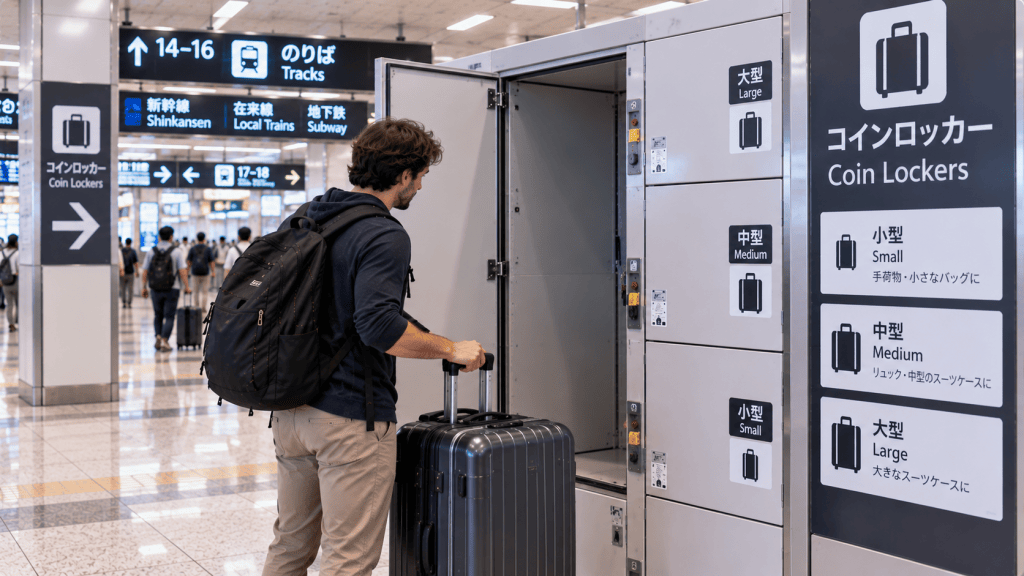
Even when your suitcase technically fits, large lockers may already be occupied when you arrive.
This is one reason travelers with very large luggage should not depend on coin lockers as their only storage plan.
If your suitcase will not fit, look for a staffed baggage storage counter or another luggage storage service nearby.
For journeys between hotels, sending your suitcase ahead can sometimes be more convenient than repeatedly carrying and storing it at stations.
Japan’s luggage forwarding services are particularly useful when you are changing cities or want to travel with only a smaller overnight bag.
9. Remember Exactly Where Your Locker Is
One of the easiest coin locker mistakes is forgetting where you stored your luggage.
This is more likely to happen at large stations where several locker areas may look similar.
Before leaving the locker, take a photo of the surrounding area.
Include nearby signs, the locker number and anything else that will help you identify the location later.
If possible, note the nearest station exit, ticket gate, floor or landmark.
You can also save the location in your phone or write a short note before beginning your sightseeing.
This may feel unnecessary when you first store your suitcase, but several hours later a large Japanese station can look very different from what you remember.
Keep any key, receipt, PIN or other retrieval information secure as well.
A locker is only convenient if you can find it again easily.
10. What If You Lose the Key, Receipt or Retrieval Information?
The method used to reopen a locker depends on the locker system.
You may need a physical key, IC card, PIN, receipt or other information.
Keep whatever you need to retrieve your belongings somewhere secure while you are away from the locker.
If you lose it or cannot open the locker, look for the contact information or instructions displayed on or near the locker.
Depending on the location, you may need to contact the locker operator or ask station staff for assistance.
You may also be asked to provide information that helps confirm that the belongings inside are yours.
Resolving the problem can take time, which is particularly inconvenient if you have a train, flight or hotel check-in ahead of you.
Before walking away from the locker, make sure you understand how you will open it again.
Taking a quick photo of the instructions or receipt can provide an additional reference, but protect any sensitive retrieval information that could allow someone else to access the locker.
11. Are There Luggage Storage Options Besides Coin Lockers?
Coin lockers are convenient, but they are not the only way to store luggage temporarily in Japan.
Some major stations, airports and tourist areas have staffed baggage storage counters or other luggage storage services.
These can be useful when your suitcase is too large for a locker or when large lockers are already full.
Depending on the service, staffed storage may also be easier for travelers carrying several bags.
Opening hours, prices, accepted luggage sizes and maximum storage periods vary, so check the conditions before leaving your belongings.
Unlike a self-service locker, a staffed counter may not be accessible at all hours.
Make sure you know the closing time and collect your luggage with enough time to spare before your next train, flight or other reservation.
When choosing between a locker and staffed storage, the most convenient option is usually the one that fits your luggage and your schedule.
12. What Should You Not Put in a Coin Locker?
A coin locker is useful for ordinary travel belongings, but it should not be treated as a place to leave anything without checking the rules.
Restrictions vary by operator and location, so read the instructions displayed at the locker.
As a practical rule, keep your passport, wallet, medication, important travel documents and other essential valuables with you.
You should also avoid storing anything prohibited by the locker operator or anything that could create a safety, hygiene or security problem.
If you are carrying unusual, fragile or particularly valuable items, a coin locker may not be the best storage option.
Do not assume that placing something inside a locker makes it fully protected against every possible problem.
For most travelers, lockers are best used for ordinary luggage, backpacks, shopping bags and similar belongings that are inconvenient to carry while sightseeing.
13. Can You Leave Your Luggage at a Hotel Instead?
Sometimes the easiest luggage storage option is your accommodation.
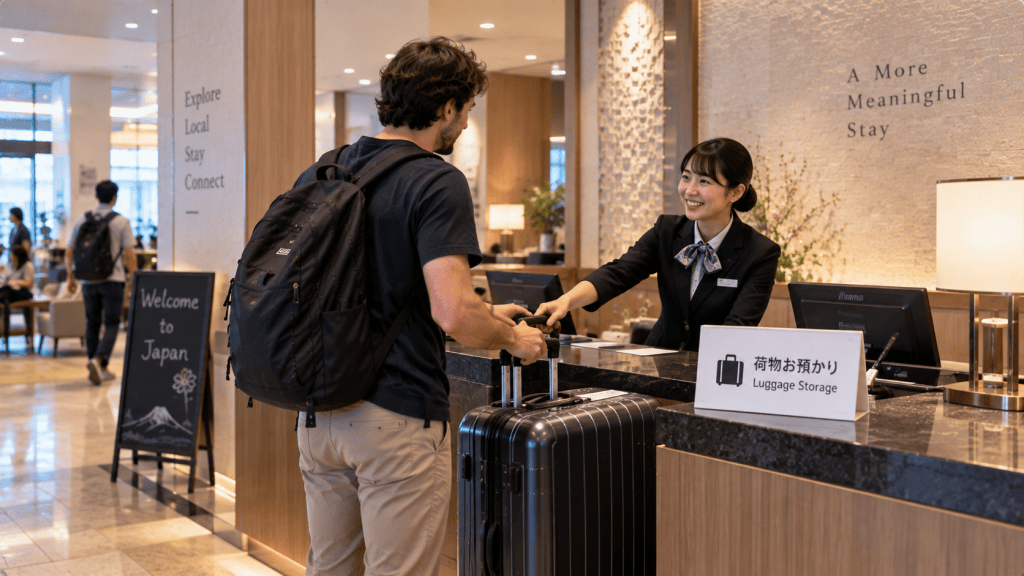
Many hotels can hold luggage for guests before check-in or after check-out, although policies vary.
If your hotel is conveniently located near your sightseeing route, leaving your suitcase there may be simpler than searching for a station locker.
However, do not assume that every hotel, guesthouse or vacation rental provides luggage storage.
Ask your accommodation in advance if this is important to your plans.
Also consider the extra travel involved.
Returning to a hotel simply to collect a suitcase may be inconvenient if the hotel is far from the station you need for your next journey.
Coin lockers are often more useful when you want to store luggage at a transportation hub and continue traveling from the same place later.
Your itinerary should determine which option is more convenient.
If you are still deciding where to stay, our Where to Stay in Japan guide explains the main accommodation options for travelers.
14. Coin Locker or Luggage Forwarding: Which Should You Use?
Coin lockers and luggage forwarding solve different travel problems.
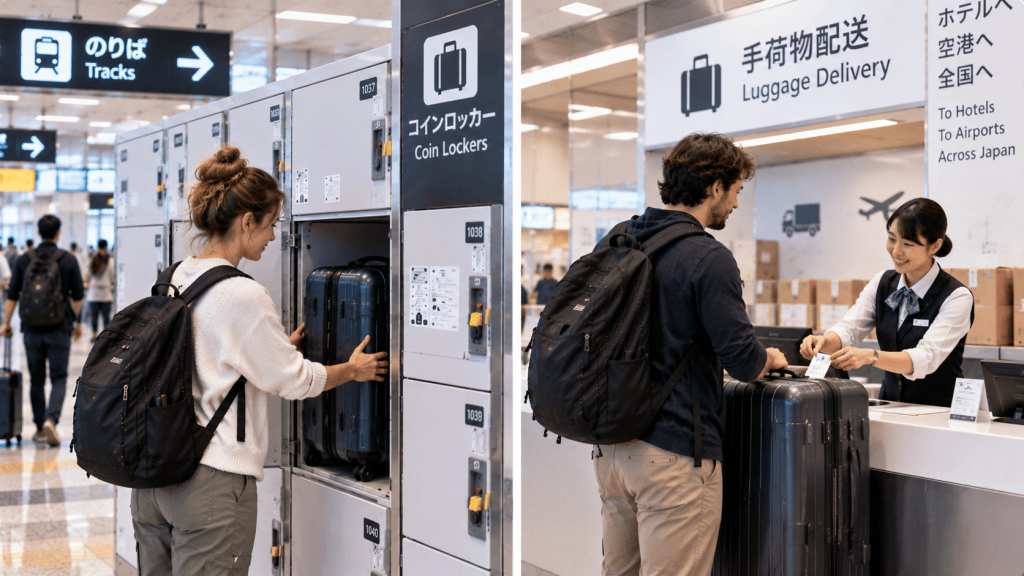
A coin locker is most useful when you want to leave a bag somewhere temporarily and return to the same location to collect it.
For example, you might store your suitcase at a station for a few hours while sightseeing before continuing your journey.
Luggage forwarding is different.
Instead of returning to collect the suitcase, you arrange for it to be delivered to another supported destination, such as your next accommodation.
This can be particularly useful when traveling between cities with large luggage.
If you only need somewhere to leave a bag for a few hours, a coin locker may be the simpler option.
If you are changing hotels or cities and do not want to carry a large suitcase on trains, luggage forwarding may be more convenient.
Some itineraries can benefit from using both during the same trip.
The important thing is to choose based on where you need your luggage next.
For details on sending bags between accommodations, see our Japan Luggage Forwarding Guide.
15. Common Coin Locker Mistakes to Avoid
Coin lockers are relatively simple to use, but a few mistakes can create unnecessary problems.
Assuming Every Suitcase Will Fit
Large lockers exist, but availability and dimensions vary. Have another option if you are traveling with oversized luggage.
Forgetting Where the Locker Is
Take a photo of the locker area, nearby signs and the locker number before walking away.
Losing the Key or Retrieval Information
Keep the key, receipt, PIN or other information needed to reopen the locker secure.
Forgetting Which IC Card You Used
If the locker uses an IC card for access, remember which card you used and keep it with you.
Assuming the Fee Covers an Exact 24-Hour Period
Locker charging systems vary. Check how additional fees are calculated before leaving luggage for an extended period.
Leaving Luggage Longer Than Allowed
Coin lockers have storage limits. Check the rules rather than assuming you can leave a suitcase for several days.
Depending on a Large Locker Being Available
Large lockers can fill quickly at busy stations. Have an alternative plan.
Ignoring Your Next Destination
Storing luggage at a station is only convenient if returning to that station makes sense for your itinerary.
Leaving Essential Items Inside
Keep your passport, medication, valuables and anything you may need urgently with you.
A minute spent checking the locker instructions and recording its location can save a lot of time later.
Conclusion: Use Coin Lockers to Travel More Easily in Japan
Coin lockers can make sightseeing in Japan much easier when you do not want to carry luggage throughout the day.
They are particularly useful when you arrive before hotel check-in, have several hours between journeys or want to explore an area before continuing to your next destination.
The basic process is simple, but locker sizes, payment methods, fees and storage limits vary.
Check the instructions before paying, remember exactly where your locker is and keep the key, receipt, IC card or other retrieval information secure.
If the lockers you need are full or your suitcase is too large, look for a staffed baggage storage service or consider whether your accommodation can hold your luggage.
And when you are traveling between cities, luggage forwarding may be more useful than temporary storage.
Using the right option at the right time can make traveling by train significantly more comfortable.
With your luggage safely stored, you can spend less time managing bags and more time exploring Japan.
 Beyond Japan Guide
Leave a comment