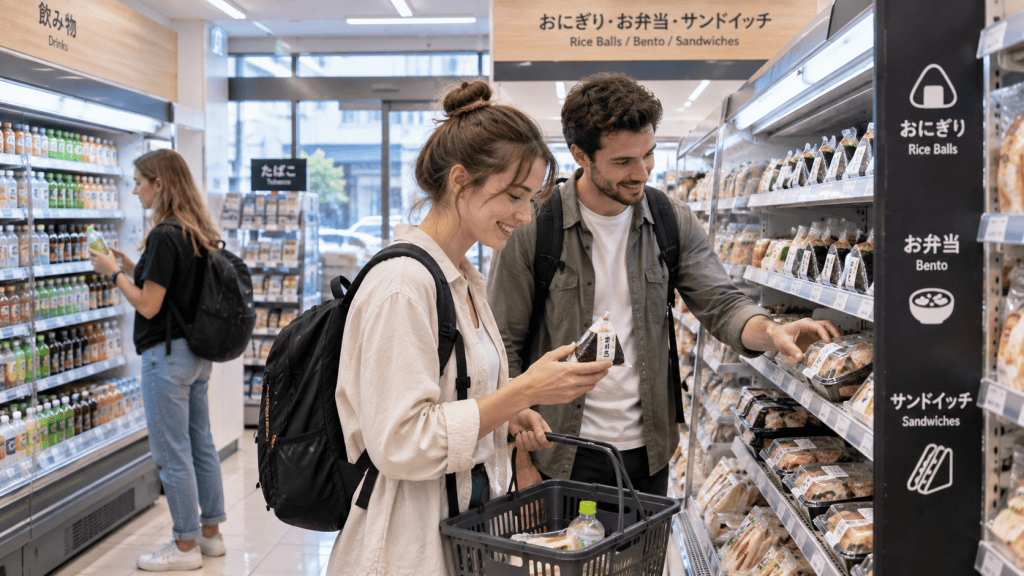
Convenience stores are everywhere in Japan, and they can quickly become one of the most useful parts of your trip.
Known as konbini in Japanese, convenience stores offer much more than snacks and drinks.
Japan’s official tourism website also provides an introduction to convenience stores in Japan and the services travelers may find there.
Travelers can use them to buy quick meals, withdraw cash, pick up everyday essentials and access a variety of other useful services.
They are particularly convenient when you arrive late, need an inexpensive breakfast, want something to eat between sightseeing stops or suddenly realize that you forgot an everyday item.
You will see major convenience store chains throughout Japan, but the exact products and services available vary by store and location.
Payment options, ATM services and other facilities can also differ, so it is useful to understand the basics rather than assuming that every store works exactly the same way.
This guide explains what to buy at Japanese convenience stores, how to pay, how travelers can use ATMs, what useful services you may find and the practical konbini tips worth knowing before your trip.
1. What Is a Konbini?
Konbini is the commonly used Japanese term for a convenience store.
You will find them throughout Japan, from major city centers and railway stations to residential neighborhoods and smaller towns.
The largest chains operate thousands of stores, but travelers do not need to choose one particular brand for every visit.
Most stores sell a broad selection of food, drinks and everyday necessities, while many also provide additional services such as ATMs, photocopying and printing.
Some locations offer seating areas or other facilities, but these are not available at every store.
Opening hours also vary. Many convenience stores operate 24 hours a day, but you should not assume that every location is open around the clock.
For travelers, the biggest advantage is simply convenience. A konbini can solve many small travel problems without requiring a special trip to a supermarket, pharmacy or restaurant.
2. What Food Should You Try at a Japanese Convenience Store?
Food is one of the main reasons travelers enjoy visiting convenience stores in Japan.
The selection goes far beyond packaged snacks.
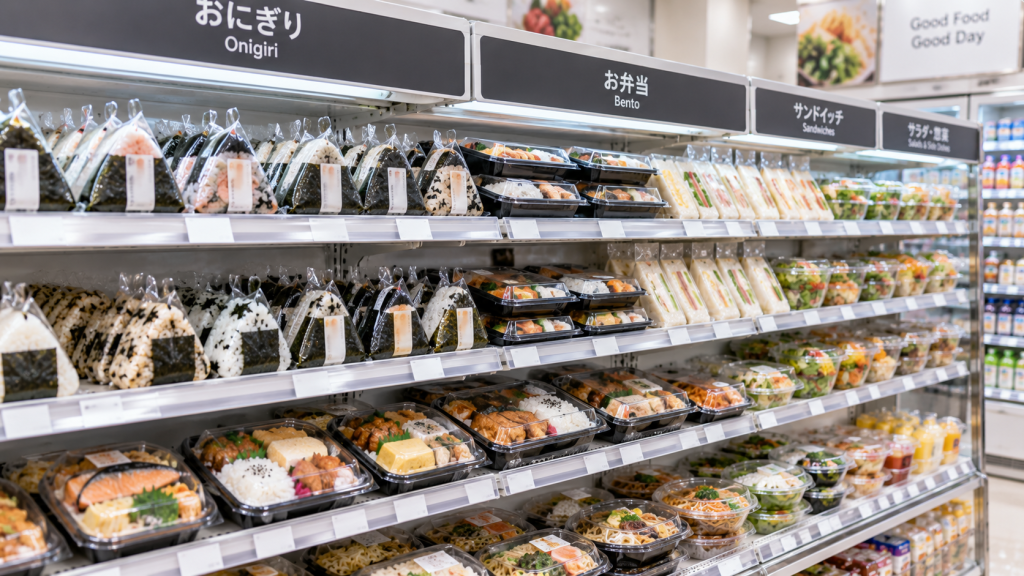
Depending on the store, you may find:
- onigiri rice balls
- bento meals
- sandwiches
- noodles
- salads
- fried chicken and other hot snacks
- bread and pastries
- desserts
- yogurt and fruit
- ice cream
Onigiri are particularly useful for travelers because they are inexpensive, portable and available with many different fillings.
Bento can provide a simple meal when you do not have time for a restaurant, while sandwiches and bakery items work well for breakfast or a quick snack.
Many stores also sell seasonal and limited-time products, so the selection may change during your trip.
Convenience store food can be extremely useful, but it should not replace exploring Japan’s restaurants, markets and regional specialties. Think of konbini as another part of the country’s food culture rather than the only way to eat cheaply.
To discover more dishes beyond the convenience store, our Japanese Food Guide introduces 15 foods worth trying during your trip.
3. Onigiri: One of the Easiest Konbini Foods to Try
If you try only one classic convenience store food in Japan, onigiri is an easy place to start.
Onigiri are rice balls that usually contain a filling and are often wrapped with nori seaweed.
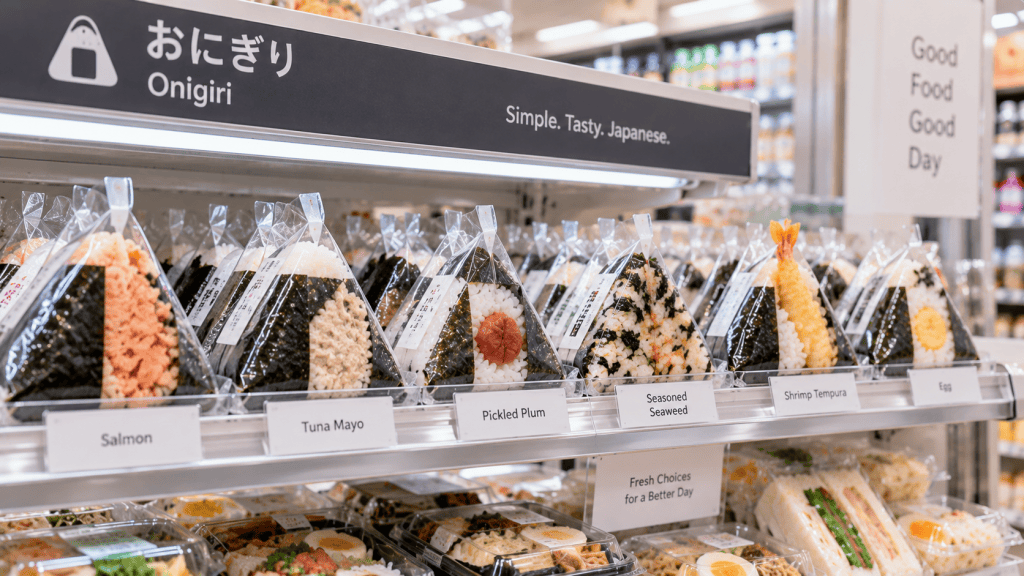
Common fillings can include salmon, tuna with mayonnaise, pickled plum and other ingredients, although the selection varies between stores.
Packaged onigiri can initially be confusing because some wrappers are designed to keep the seaweed separate from the rice until you open them.
Follow the numbered instructions printed on the package rather than tearing the wrapper open at random.
Even if you cannot read Japanese, pictures and numbers on the packaging often make the opening sequence easier to understand.
If you have food allergies or dietary restrictions, however, do not rely on appearance alone to determine the ingredients.
Onigiri are particularly convenient for breakfast, a quick snack or a light meal while traveling between destinations.
4. Bento, Hot Snacks and Quick Meals
Convenience stores are also useful when you want something more substantial than a snack.
Bento boxes can include rice together with meat, fish or other side dishes, while noodle dishes, curry and other prepared meals may also be available.
Some refrigerated meals are intended to be heated before eating.
If heating is available, staff may ask whether you want the food warmed, or the store may provide a microwave for customer use.
Procedures vary by store, so follow the instructions at the location you are using.
Near the register, you may also see hot foods such as fried chicken, croquettes or other snacks.
These can be convenient when you need something quick between trains or sightseeing stops.
If you are unsure how to order an item from the heated display, pointing politely at what you want is usually enough to begin the interaction.
As with any prepared food, the selection changes by store, time of day and availability.
5. Drinks, Coffee and Desserts
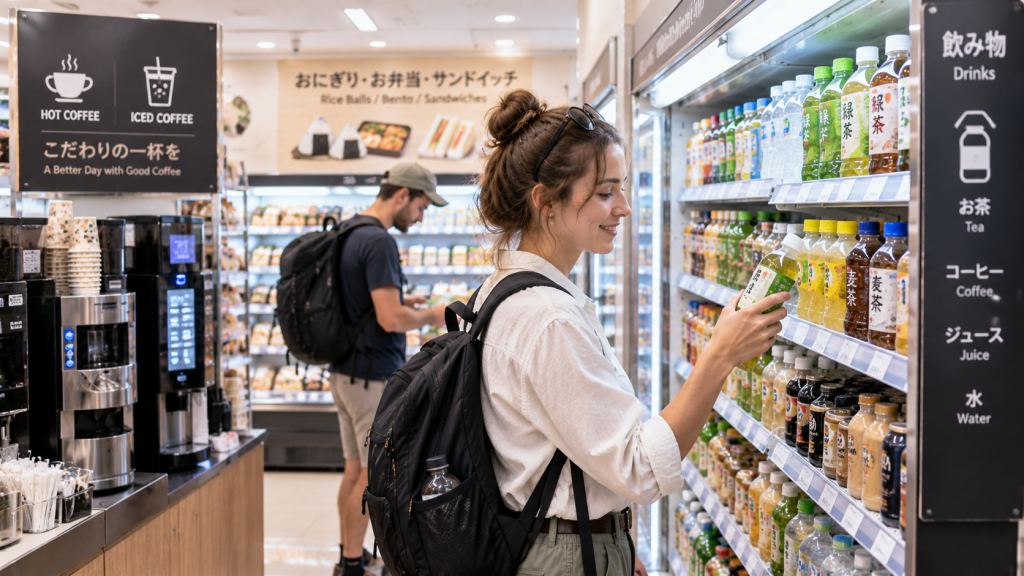
Japanese convenience stores also have a large selection of drinks.
You will usually find bottled water, tea, soft drinks, juice and other beverages in refrigerated cases.
Many stores also sell coffee, although the ordering and preparation process differs between chains and locations.
Some coffee is purchased at the register and prepared using a machine, while other products are sold ready to drink.
Convenience stores are also well known for desserts and sweets.
Depending on the store and season, you may find puddings, cakes, ice cream, traditional-style sweets and limited-time products.
Trying a few seasonal items can be an easy way to discover flavors that may not be available during another time of year.
Just remember that new products appear frequently, so specific recommendations can become outdated quickly. Exploring the shelves yourself is often part of the fun.
6. How to Pay at a Japanese Convenience Store
Paying at a convenience store in Japan is usually straightforward.
Cash is widely accepted, and many stores also accept credit cards, IC cards and other cashless payment methods.
However, the exact payment options can vary by store, location and transaction.
At some registers, you may select your payment method on a screen rather than telling the staff directly.
If you are paying with cash, place or insert the money where indicated rather than worrying about following a complicated procedure.
If you plan to use a credit or debit card, it is still useful to carry some Japanese yen as a backup in case your card is not accepted or a particular transaction requires another payment method.
You do not need to understand every cashless payment system you see at the register. For most international travelers, a combination of a payment card, some cash and an IC card is usually enough for everyday purchases.
7. Can You Pay With an IC Card at a Konbini?
Transportation IC cards can be useful for more than trains and buses.
Many convenience stores accept major IC cards for everyday purchases, making them a convenient payment option when you already have one for transportation.
Look for the relevant IC card or electronic money symbols near the register.
When paying, select or tell the staff that you want to use an IC card if necessary, then tap the card or compatible device on the reader.
Acceptance can vary by store and transaction, so keep another payment method available.
Your IC card also needs sufficient stored value to complete the purchase.
Using an IC card at convenience stores can be especially useful for small purchases such as drinks, snacks and breakfast because you do not need to handle coins each time.
If you are planning to use an IC card during your trip, our Getting Around Japan guide explains how IC cards work together with trains and other transportation in Japan.
8. Using ATMs at Japanese Convenience Stores
Convenience store ATMs can be extremely useful when you need Japanese yen during your trip.
However, not every ATM accepts every card issued overseas.
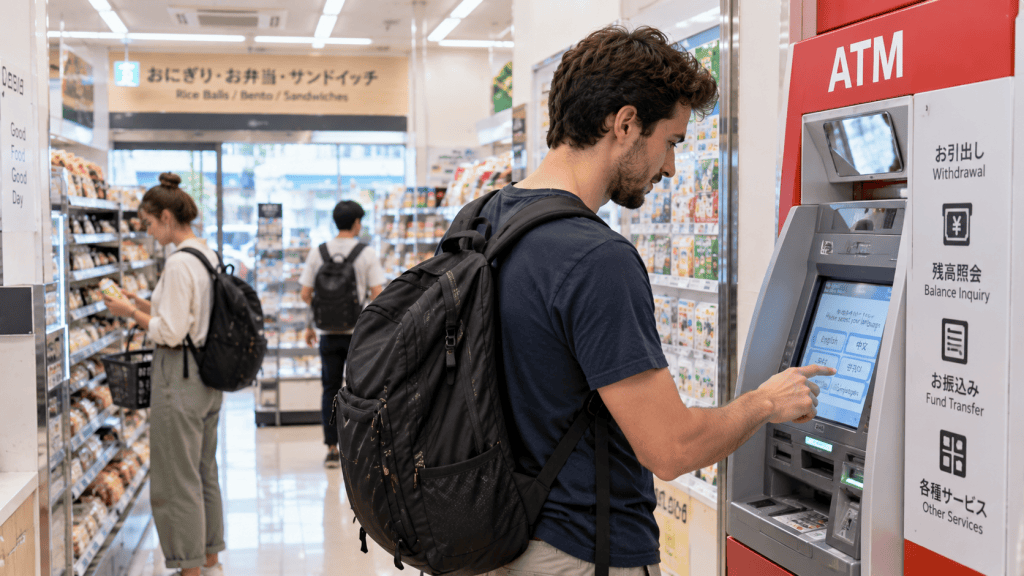
One widely available option is Seven Bank. Its ATMs accept a range of overseas-issued cards, although Seven Bank notes that even cards displaying a supported brand may sometimes not be accepted.
Fees, withdrawal limits and available service hours can also depend on the card and transaction.
Many ATMs provide an English-language interface, making the withdrawal process relatively easy for international visitors.
Before traveling, make sure you know the PIN for the card you plan to use and check whether your own bank charges international withdrawal or foreign transaction fees.
It is also a good idea to carry more than one way to access money rather than depending entirely on a single card.
If one ATM does not accept your card, do not assume that all ATMs in Japan will reject it. Try another compatible ATM or check the official information from your card issuer and the ATM operator.
9. Buy Everyday Travel Essentials
Convenience stores can also help when you suddenly realize that you forgot something at your hotel or did not pack an everyday item.
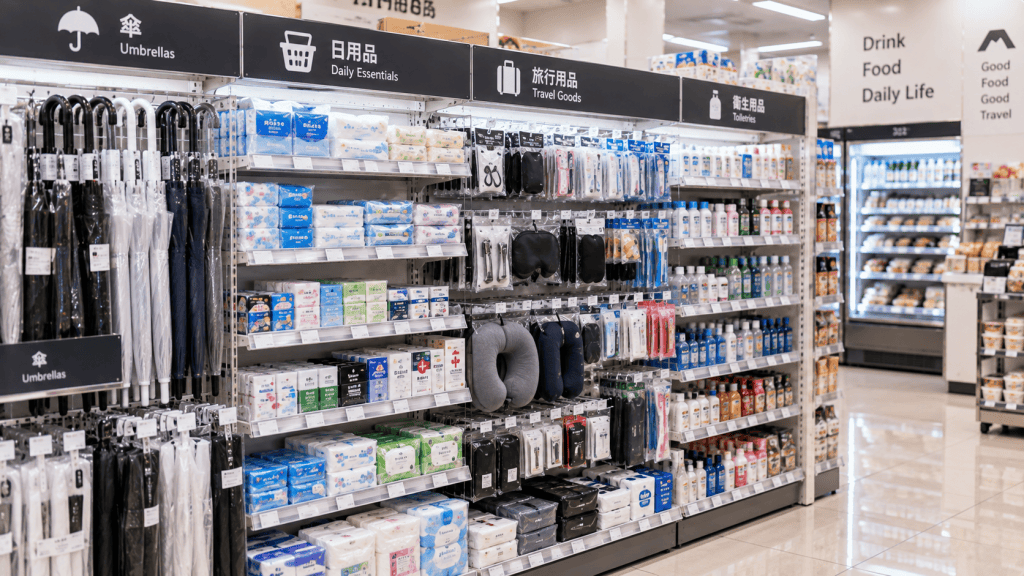
The exact selection varies, but stores may carry items such as:
- tissues
- masks
- basic toiletries
- umbrellas
- socks or other simple clothing items
- batteries
- charging accessories
- stationery
Larger stores may have a wider selection, while smaller locations may focus mainly on food and drinks.
This makes a konbini useful for minor travel problems, particularly early in the morning or late in the evening when other shops may be closed.
However, convenience stores are not a substitute for every type of specialist shop.
If you need medication, specific electronics, specialized travel equipment or a particular personal-care product, another retailer may offer a better selection.
Think of the konbini as the first place to check for simple everyday necessities rather than assuming it will have everything you need.
To prepare before you leave home, our Japan Packing List covers the essential items worth bringing for a trip to Japan.
10. Toilets, Trash Bins and Other Store Facilities
Convenience stores can provide useful facilities during a long day of sightseeing, but availability varies considerably between locations.
Some stores have customer toilets, while others do not provide public restroom access.
Even when a toilet is available, follow any signs or instructions and do not assume that every store offers the same facilities.
Trash and recycling bins may also be available at some locations, but their placement and availability vary.
If bins are provided, use them according to the labels and do not leave unrelated trash beside the bins or elsewhere in the store.
Some convenience stores may also have seating areas, but these are not universal.
When seating is available, follow the store’s rules and avoid occupying the space longer than necessary during busy periods.
The simplest rule is to treat convenience stores as private businesses rather than public facilities. Use the services they provide respectfully and follow the instructions at each location.
11. Printing, Copying and Other Useful Konbini Services
Japanese convenience stores can offer services that go far beyond shopping for food and drinks.
Many stores have multi-function machines that can be used for photocopying and printing.
This can be useful if you need a physical copy of a travel document, reservation confirmation or other information during your trip.
The exact functions, supported file types and operating procedures vary depending on the convenience store chain and machine.
Some machines may offer English or other language options, but not every function will necessarily be equally easy for international visitors to use.
If you know that you will need to print an important document, check the instructions for the specific convenience store service rather than waiting until the last minute.
Convenience stores may also offer other useful services, but availability differs considerably between chains and locations.
Think of these machines as a useful backup during your trip rather than assuming that every konbini provides exactly the same services.
12. Tickets and Services Can Be More Complicated Than Shopping
You may hear that convenience stores in Japan can be used to buy tickets, make certain payments or access other services.
This is true, but these services are not always as simple for international travelers as buying food at the register.
Depending on the store and service, you may need to use a multi-function terminal, enter reservation information or follow instructions that are partly in Japanese.
Some long-distance bus tickets, event tickets and other services may be available through convenience stores, but availability and procedures vary.
Do not assume that every ticket can be purchased at every chain.
If a particular ticket is important to your itinerary, check the official website of the transport operator, attraction or event before relying on a convenience store.
Booking online may be easier when an official English-language reservation system is available.
The convenience store option is useful, but it should be treated as one possible purchasing method rather than the universal way to buy tickets in Japan.
13. Where Should You Eat Your Convenience Store Food?
After buying food at a convenience store, think about where you are going to eat it.
Some larger convenience stores have designated seating areas, but many do not.
If the store provides an eating space, follow any signs or rules and use the area considerately.
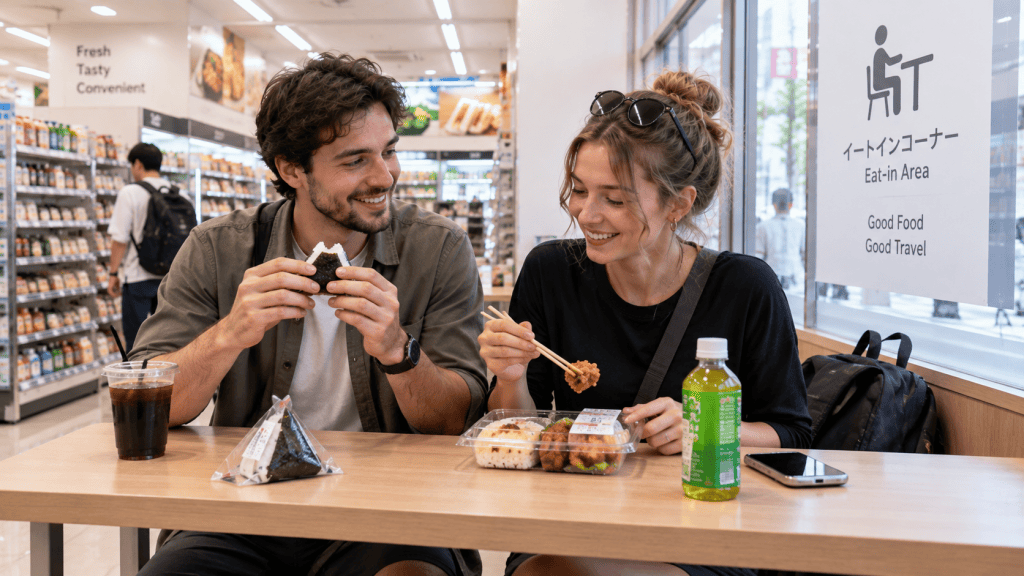
Otherwise, wait until you reach an appropriate place such as your hotel room, accommodation or another location where eating is permitted.
Eating while walking is not automatically forbidden everywhere in Japan, but it is better to pay attention to the setting rather than assuming that every public space is suitable.
Avoid eating where you would block pedestrian traffic, disturb other people or create a problem with litter.
On ordinary commuter trains, eating a convenience store meal is generally not appropriate. Long-distance trains such as the Shinkansen are different, where eating at your seat is commonly accepted.
When in doubt, look at the environment around you and follow any posted rules.
14. Can Convenience Stores Help You Travel Japan on a Budget?
Convenience stores can be useful when you are trying to control your daily travel expenses.
A simple breakfast, snack or quick meal from a konbini can sometimes be more practical than visiting a restaurant every time you are hungry.
They can be particularly helpful on busy sightseeing days when convenience matters as much as price.
However, do not assume that convenience stores are always the cheapest place to buy everything.
Supermarkets, bakeries and other local shops may offer better value for certain foods and everyday items.
More importantly, saving money does not mean that every meal should come from a convenience store.
Japan has an enormous variety of affordable restaurants, noodle shops, casual dining options and regional foods worth experiencing.
A better approach is to use konbini strategically — perhaps for breakfast, drinks or occasional quick meals — while leaving room in your budget to explore Japan’s wider food culture.
For a broader breakdown of accommodation, transportation, food and everyday expenses, see our Japan Travel Budget guide.
15. Common Convenience Store Mistakes to Avoid
Japanese convenience stores are easy to use, but a few simple mistakes can make the experience less convenient.
Assuming Every Store Is Open 24 Hours
Many convenience stores operate around the clock, but not every location does. Check current opening hours when a particular store is important to your plans.
Assuming Every ATM Will Accept Your Card
International card acceptance varies. Carry another way to access money in case your preferred card does not work.
Depending on One Payment Method
Cards and IC cards are widely useful, but carrying some cash gives you a backup.
Expecting Every Store to Have the Same Services
Toilets, seating, ATMs, printing machines and other facilities vary by location.
Ignoring Food Allergy or Dietary Information
Do not identify ingredients only from the appearance of the food. Check available labeling and ask for help when necessary.
Eating Wherever It Is Most Convenient
Think about whether the place is appropriate for eating rather than automatically opening your meal as soon as you leave the register.
Leaving Trash Behind
Use appropriate bins when they are available. If you cannot find one, keep your trash with you until you can dispose of it properly.
Most konbini mistakes are easy to avoid. Treat the store and the surrounding area considerately, check important information rather than making assumptions and use convenience stores as one practical part of your Japan trip.
For more practical problems to avoid on your first visit, read our Japan Travel Mistakes guide.
Conclusion: Make Konbini Part of Your Japan Trip
Japanese convenience stores are much more than places to buy snacks.
During your trip, they can provide quick meals, drinks, cash access, everyday necessities and useful services when you need them.
You do not need to understand every machine, payment system or service before arriving in Japan.
Start with the basics: keep more than one payment option available, check ATM compatibility before depending on a particular card and remember that services vary between stores.
When buying food, try classic options such as onigiri and bento, but leave plenty of room in your itinerary for restaurants, markets and regional specialties as well.
Most importantly, use convenience stores considerately. Follow the rules of each location, eat in appropriate places and dispose of your trash responsibly.
Once you understand the basics, stopping at a konbini becomes an easy part of everyday travel in Japan — whether you need breakfast before an early train, a quick drink during sightseeing or a forgotten travel essential late in the evening.
 Beyond Japan Guide
Leave a comment