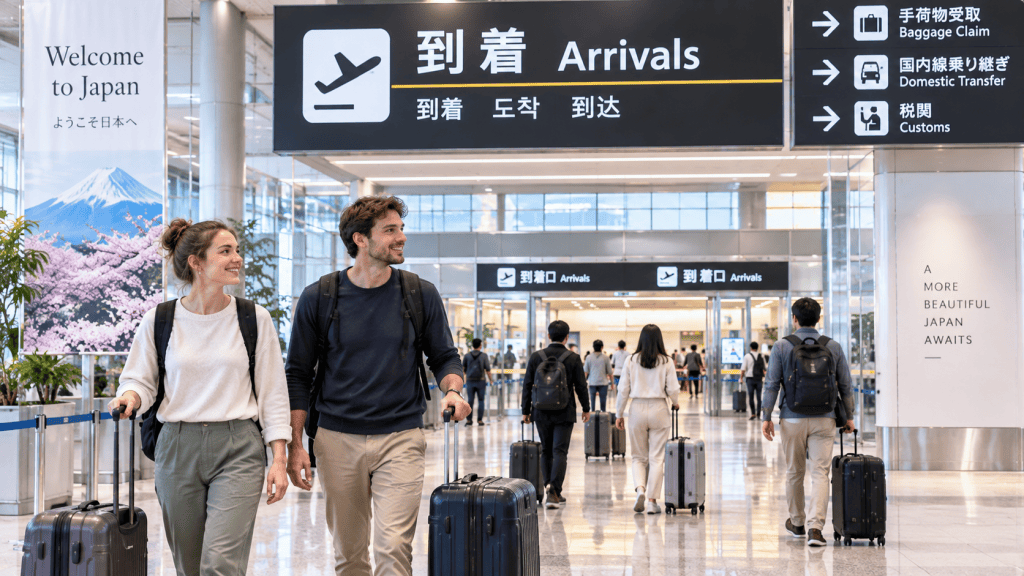
Arriving in Japan for the first time can be exciting, but the airport can also feel like the first major challenge of your trip.
After getting off the plane, you may need to go through immigration, collect your luggage, complete customs procedures, connect to the internet, get Japanese yen and figure out how to reach your hotel.
Fortunately, Japan’s major international airports are generally well organized, and many signs and transportation services provide information in English.
You do not need to arrange everything at the airport, either. Some things can be prepared before departure, while others are easier to handle after you arrive.
The most important thing is to understand the basic order of what happens after landing and avoid trying to solve every part of your trip at once.
This guide walks you through what to do after arriving at an airport in Japan, from immigration and baggage claim to internet access, money, transportation and luggage delivery.
Whether you land at Tokyo’s Haneda or Narita Airport, Kansai International Airport near Osaka or another international gateway, the basic preparation can make your first few hours in Japan much easier.
1. What Happens After You Land in Japan?
After leaving the aircraft, follow the signs for arrivals and immigration.
The exact route depends on the airport and terminal, but international passengers generally proceed through arrival procedures before entering the public area of the airport.
You will typically need to complete several steps:
- immigration
- baggage claim
- animal and plant quarantine procedures when applicable
- customs
- arrival lobby
Keep your passport and other necessary travel information easily accessible until you have completed the arrival process.
Do not pack important documents, medication or other essentials that you may need immediately after landing inside checked luggage.
The time required to complete arrival procedures can vary considerably depending on the airport, flight schedule, passenger volume and your individual circumstances.
For that reason, avoid planning a tight train connection or another time-sensitive activity immediately after your scheduled landing time.
2. Immigration and Visit Japan Web
Japan offers Visit Japan Web, an official online service that allows travelers to prepare information for immigration and customs procedures before arrival. The service is available in English and other languages.
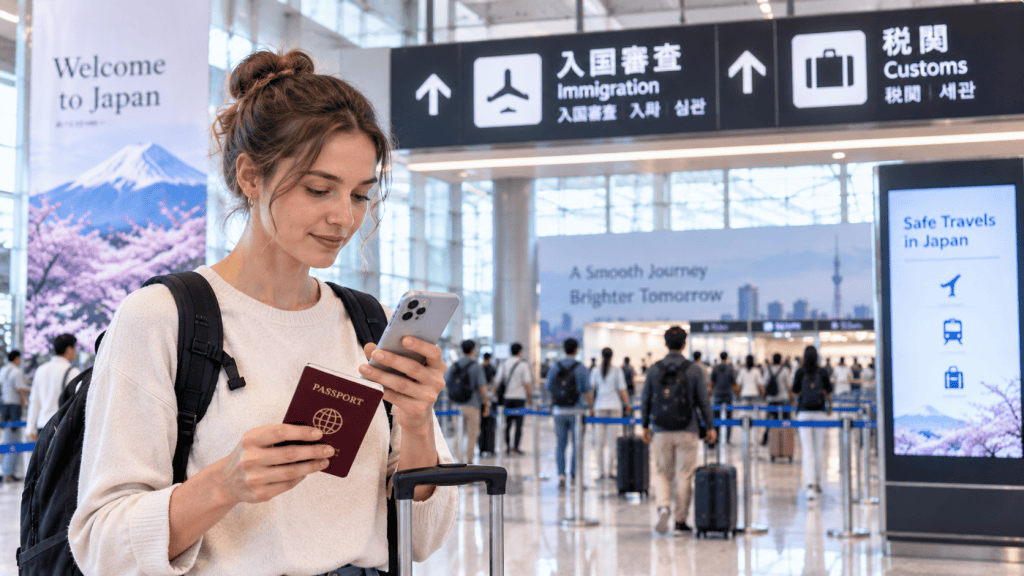
Using the service before your flight can make it easier to have the necessary information ready when you enter Japan.
However, requirements and procedures can change, so check the current official information before traveling rather than relying on an old screenshot, blog post or social media video.
Make sure the information you enter matches your passport and travel details.
It is also useful to have access to the information after landing rather than assuming that you will immediately have a reliable internet connection.
If you are traveling with family members or have circumstances that require additional procedures, check the instructions that apply to your situation before departure.
The goal is simple: prepare as much as you reasonably can before boarding your flight so that your arrival in Japan is easier.
3. Collect Your Checked Luggage
After immigration, follow the signs to baggage claim and check the information screens for your flight.
Wait at the correct carousel and make sure you collect the right suitcase.
Many suitcases look similar, so checking your baggage tag or using a distinctive luggage tag can help prevent mistakes.
Before leaving the baggage claim area, inspect your luggage briefly for obvious damage or missing items.
If your checked baggage does not arrive or appears to have been damaged, report the problem at the appropriate airline or baggage service counter before leaving the controlled area when possible.
This is also a good time to make sure that you still have your passport, wallet, phone and other important belongings before continuing through the airport.
If you are carrying items subject to quarantine or other restrictions, follow the relevant airport instructions rather than proceeding directly toward the exit.
4. Go Through Customs
After collecting your luggage and completing any required quarantine procedures, you will proceed through customs before entering the public arrivals area.
Japan Customs provides information for travelers entering the country, and the procedures you need to follow depend on what you are carrying.
Do not assume that an item is permitted simply because it is legal or commonly carried in your home country.
Food, plants, animal products, medicines and other items can be subject to restrictions or additional procedures.
If you are unsure whether something needs to be declared, check official information before traveling.
Being accurate about what you are bringing into Japan is much better than trying to guess after you arrive.
Once you have completed the required arrival procedures and entered the public arrivals lobby, you can begin dealing with the practical parts of your trip such as internet access, money and transportation.
5. Get Connected to the Internet
Having internet access soon after arriving makes almost everything else easier.
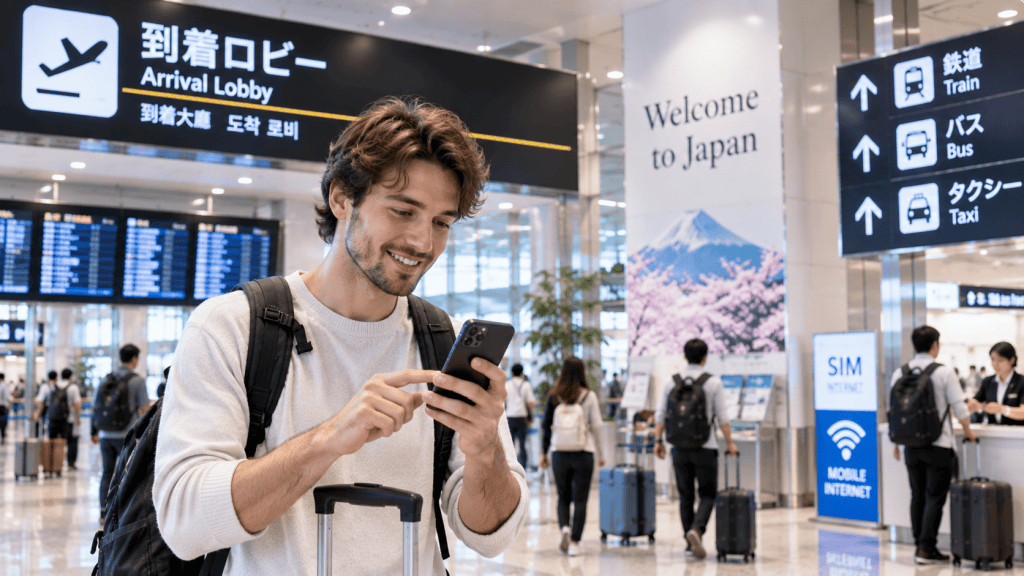
You may need your phone to check your hotel address, use maps, look up train routes, contact your accommodation or access reservation information.
If you installed an eSIM before departure, you may be able to activate or connect it after arriving in Japan.
Other travelers may prefer a physical SIM card or pocket Wi-Fi.
Which option is best depends on your phone, trip length, number of devices and how you plan to use mobile data.
Airport Wi-Fi can be useful while you are getting organized, but you should not make your entire trip dependent on finding free Wi-Fi.
If possible, decide how you will stay connected before you arrive.
For a full comparison of the options, see our Japan eSIM, SIM Card & Pocket Wi-Fi guide.
6. Get Some Japanese Yen
Even though card and cashless payments are common in Japan, having some Japanese yen after arrival is still useful.
You may need cash for smaller businesses, local transportation in some areas, coin lockers or other situations where your preferred payment method is not available.
You do not need to exchange your entire travel budget at the airport.
Depending on your card and bank fees, withdrawing yen from a compatible ATM after arrival may be another option.
Before traveling, check whether your card can be used internationally and understand any foreign transaction or ATM fees charged by your bank.
It is also sensible to carry more than one payment method in case one card does not work.
For a broader explanation of cash, cards and everyday travel expenses, see our Japan Travel Budget guide.
7. Do You Need an IC Card at the Airport?
An IC card can make everyday transportation easier once you begin traveling around Japan.
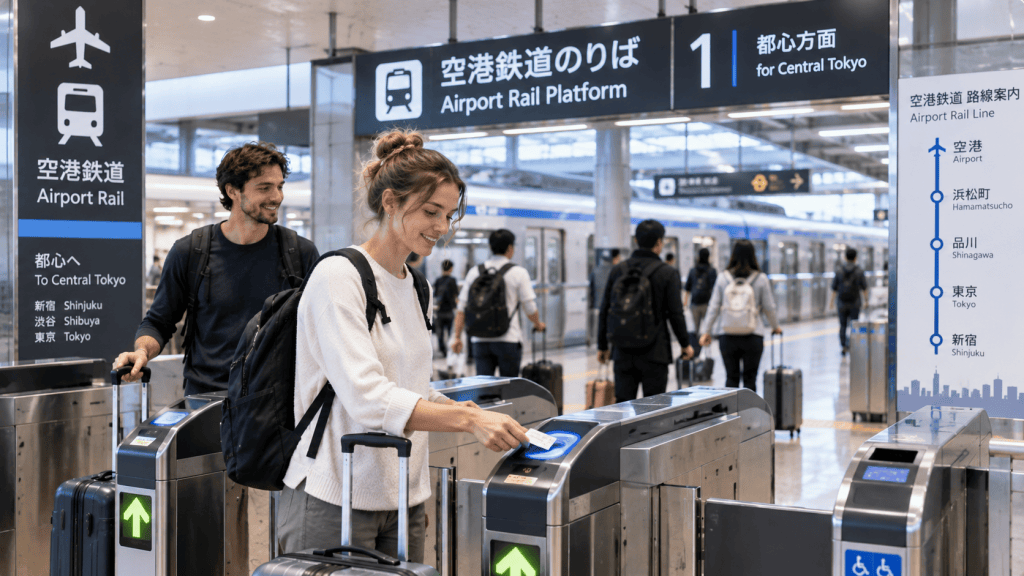
Depending on where you arrive and what is currently available, you may be able to obtain or use a compatible IC card for trains, buses and other purchases.
However, you do not need to make getting a particular IC card your first priority immediately after landing.
Availability, sales locations and card types can change, and different regions use different IC card brands.
Many major transportation IC cards are interoperable across large parts of Japan, which means travelers usually do not need a different card for every city they visit.
If you already have a compatible mobile IC card set up on your phone, that may also be useful during your trip.
Before buying or setting up a card, check the current information for the airport and transportation system you plan to use.
For a more complete explanation, our Getting Around Japan guide covers IC cards, trains and the Shinkansen.
8. Choose How to Travel From the Airport to the City
Japan’s major international airports usually offer several ways to reach the city, including trains, airport buses and taxis.
For an overview of transportation options from major airports, see JNTO’s official guide to airport access in Japan.
The best option is not always the fastest one.
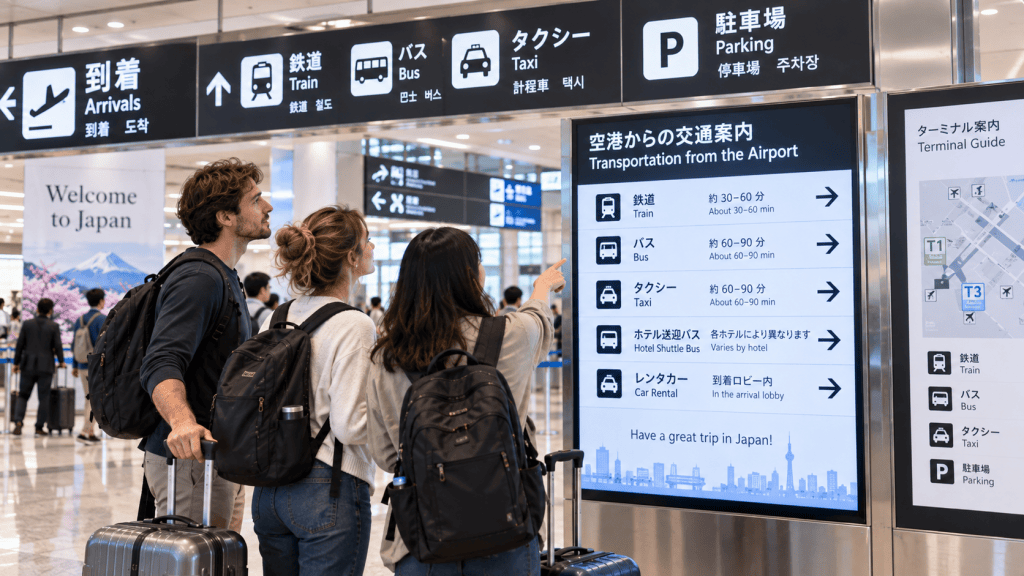
Think about where your accommodation is located, how much luggage you have, how many people are traveling together and what time you arrive.
Trains can be fast and convenient, particularly when your hotel is near a major station.
Airport buses can be useful when they stop close to your hotel or another convenient destination.
Taxis provide door-to-door convenience, but a long journey from an airport can be significantly more expensive than public transportation.
Do not simply board the first train you see.
Check your destination and compare the available routes before buying a ticket.
Also remember that transportation schedules are not unlimited. If your flight arrives late at night, check the last train or bus rather than assuming that public transportation will still be operating when you finish arrival procedures.
9. Arriving at Haneda or Narita Airport
If Tokyo is your first destination, you will most likely arrive at Haneda Airport or Narita International Airport.
Haneda is closer to central Tokyo, which can make the journey into the city relatively straightforward.
Narita is farther from central Tokyo, so you should allow more time for the journey to your accommodation.
Both airports have multiple transportation options, including rail and airport bus services.
The best route depends on where you are staying.
A traveler heading to Shinjuku may choose differently from someone staying near Tokyo Station, Ueno or another part of the city.
Do not choose your airport transfer only by looking at the final destination name on a train.
Consider the entire journey, including transfers and how easy it will be to move through stations with your luggage.
Also check your actual arrival terminal. Airport terminals and airline operations can change, and transportation access can differ depending on where your flight arrives.
If Tokyo is your first stop, our Tokyo for First-Time Visitors guide can help you understand the city’s main areas before choosing where to stay and how to reach your accommodation.
10. Arriving at Kansai International Airport
If Osaka or the Kansai region is your first destination, Kansai International Airport (KIX) is one of the main international gateways.
From the airport, travelers can use rail services, airport buses and other transportation to reach Osaka and destinations elsewhere in the Kansai region.
The best route depends on where you are staying.
For example, a convenient route to the Namba area may be different from the best option for Osaka Station, Kyoto or another destination.
Before leaving the airport, check the complete journey rather than simply choosing the service with the shortest advertised travel time.
Transfers, luggage and the location of your accommodation can make a slightly slower route more convenient overall.
If you arrive late in the evening, check current transportation schedules before assuming that your preferred train or bus will still be operating.
Travelers continuing directly to Kyoto should also compare the available airport transportation with their arrival time and final accommodation location.
For travelers staying in Osaka, our Osaka for First-Time Visitors guide explains the main areas, transportation and practical tips for exploring the city.
11. Decide What to Do With Your Luggage
Large suitcases can make the journey from the airport more tiring, especially if your route involves crowded trains, stairs or multiple transfers.
You do not always need to carry every bag with you all the way to your accommodation.
Luggage delivery services are available at major airports and can allow you to send a suitcase to a hotel or another supported destination.
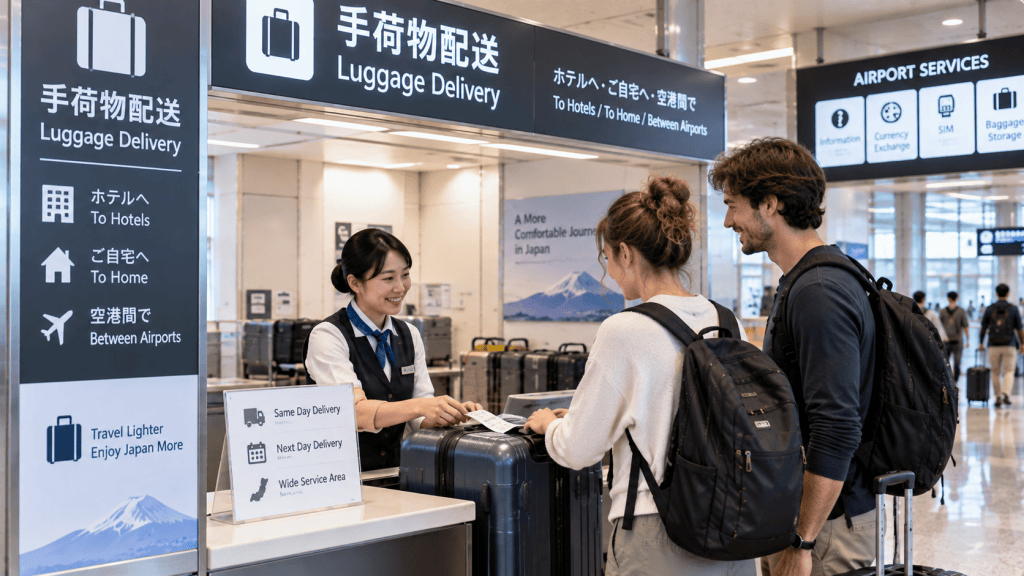
This can be particularly useful if you plan to begin sightseeing before hotel check-in or want to travel more comfortably on public transportation.
However, luggage delivery is not always immediate.
Delivery times depend on the destination, service, drop-off time and other conditions, so you should not assume that your suitcase will arrive at your hotel on the same day.
Keep anything you may need before your luggage arrives — such as medication, travel documents, valuables and a change of clothes — with you.
For a complete explanation of how the service works, see our Japan Luggage Forwarding Guide.
12. What if You Arrive Late at Night?
A late-night arrival requires a little more planning than landing during the day.
Trains and airport buses do not operate all night, and the final departure times vary by airport, route and day.
Your scheduled landing time is also not the same as the time you will leave the airport.
Immigration, baggage claim, customs and other arrival procedures can take time, and flight delays can reduce your transportation options further.
Before departure, check how you will reach your accommodation if you miss the last convenient train or bus.
Depending on the airport and your situation, alternatives may include another bus or rail service, a taxi or staying near the airport until the following morning.
If you know that your flight arrives late, choosing accommodation with a simple airport connection can make the first night considerably easier.
Do not build a plan that depends on completing immigration and baggage claim within an unrealistically short amount of time.
13. Don’t Try to Do Everything at the Airport
Japanese airports provide many useful services, but that does not mean you need to complete every travel task immediately after landing.
After a long international flight, it is easy to spend unnecessary time comparing SIM cards, transportation tickets, exchange counters and other services while tired.
Prepare what you can before departure.
For example, you may be able to arrange your internet connection in advance, save your hotel address on your phone and research the basic route from the airport to your accommodation.
Then concentrate on the things you actually need after arrival.
You can often deal with less urgent tasks later, once you have reached your hotel and had time to get organized.
The goal of your first few hours in Japan should not be to complete a long checklist.
It should be to enter the country successfully, collect your belongings, get connected if necessary and reach your accommodation safely and comfortably.
14. Keep Your Hotel Information Easy to Access
Before your flight, save the name, address and contact information for your first accommodation somewhere you can access easily.
Do not depend entirely on opening a booking app after landing.
Keeping a screenshot or offline copy of your hotel information can be useful if your mobile connection is not working yet.
It is particularly helpful to have the address available in a form you can show someone if you need assistance.
Also check the hotel’s check-in hours and instructions before traveling.
If your flight is delayed and you expect to arrive significantly later than planned, contact the accommodation when necessary rather than assuming that late check-in will always be possible.
Knowing exactly where you are going also makes it easier to compare airport trains, buses and taxis before leaving the terminal.
15. Common Airport Arrival Mistakes to Avoid
Your arrival in Japan is usually straightforward, but a few mistakes can make the first few hours unnecessarily stressful.
Booking a Tight Connection After Landing
Do not assume that you will leave the airport immediately after the aircraft lands. Immigration, baggage and customs take time.
Forgetting to Check Your Arrival Terminal
Large airports have multiple terminals. Confirm where your flight arrives and use transportation information for the correct terminal.
Depending on Airport Wi-Fi for Your Entire Trip
Airport Wi-Fi can help when you arrive, but arrange a reliable internet option for the rest of your journey.
Exchanging All Your Money Without Comparing Options
You do not necessarily need your entire travel budget in cash immediately after landing.
Assuming Every International Card Will Work
Carry more than one payment option and check international card compatibility before traveling.
Choosing Airport Transportation Without Checking Your Hotel Location
The fastest train on paper may not be the easiest option if it requires difficult transfers with luggage.
Ignoring the Last Train or Bus
Late arrivals require extra planning. Check current schedules rather than assuming public transportation runs all night.
Carrying Large Luggage When You Do Not Need To
Consider luggage delivery when it makes the journey to your accommodation significantly easier.
Trying to Complete Every Travel Task Before Leaving the Airport
Handle the essentials first. Many things can wait until you reach your accommodation.
A little preparation before your flight can prevent most of these problems and make your arrival in Japan much more relaxed.
For more first-trip problems worth avoiding, see our Japan Travel Mistakes guide.
Conclusion: Start Your Japan Trip With a Smooth Arrival
Your first hour or two in Japan does not need to be complicated.
Follow the arrival procedures one step at a time, collect your luggage and make sure you have the essentials you need before leaving the airport.
Having internet access, some Japanese yen and a clear route to your accommodation can make the transition from the airport to your first destination much easier.
You also do not need to organize every part of your trip immediately after landing.
Prepare what you can before departure, keep important information accessible and leave less urgent tasks until you have reached your accommodation.
If you are traveling with large luggage, consider whether airport delivery could make your first journey easier.
And if you arrive late at night, check transportation schedules and backup options before your flight rather than trying to solve the problem after landing.
Once you have cleared the airport and reached your accommodation, the complicated part is over.
From there, you can start exploring Japan at your own pace.
 Beyond Japan Guide
Leave a comment